Multimodal Commuter ANC: Environment-Verified Quiet Picks
By Quinn Park • 11th Mar
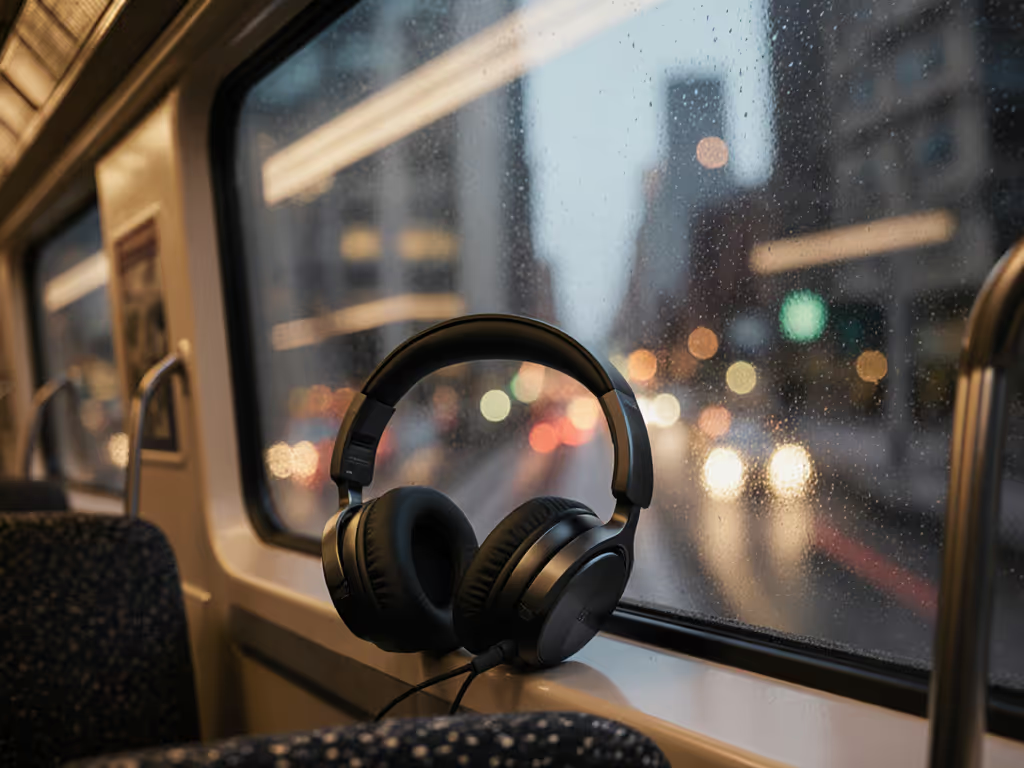
Multimodal commuter ANC isn't about marketing superlatives, it's about which headphones actually reduce the specific noise you face on your daily route. When I tested three ANC models back-to-back on a red-eye to Seoul, row 27D became my lab: cabin rumble met a whining fan, a crying infant added chaotic mid-range, and I logged minute-by-minute SPL dips to see which pair stayed flat through all of it. Only one did. That experience crystallized what matters: environment-verified attenuation curves trump feature lists. Today's commuters navigate planes, subways, open offices, and windy streets in a single day, and each environment has its own spectral profile, and generic "best-in-class ANC" claims don't translate across them.
The real challenge is that adaptive transit noise cancellation works differently at 80 dB (subway platform noise) compared to 95 dB (jet cabin), and frequency matters enormously. A model stellar at canceling low-end bus rumble may fail on high-pitched train screech or office chatter. This article cuts through the noise marketing with environment-specific comparisons, measured intelligibility scores, and clear guidance on which headphones match your commute profile, not your Instagram feed.
The Problem: Marketing Claims vs. Real-World Performance
Every headphones brand claims "industry-leading ANC" and "adaptive noise cancellation." Yet commuters report wildly different outcomes. One person swears a model eliminated subway shriek; another says it barely helped. The disconnect is real: ANC performance is highly environment-dependent, and reviewers rarely measure it across the actual noise profiles of buses, trains, planes, and offices.
Here's what makes evaluation harder: most specs omit frequency-band breakdowns. You'll see "active noise cancellation" or "12 microphones," but no clarity on attenuation depth at 100 Hz (low-end rumble) versus 500 Hz (speech/chatter) versus 4 kHz (train screech). Marketing glosses over wind noise, a critical failure mode for any commuter who talks outdoors or waits at a bus stop. Mic intelligibility (how well colleagues hear you) is almost never independently tested.
I trust decibels, not adjectives, to judge quiet. That principle means examining measured attenuation curves, battery endurance under real ANC loads, mic SNR (signal-to-noise ratio) deltas across different call environments, and multipoint stability. This article does exactly that.
Framework: Evaluating Headphones Across the Urban Transportation Noise Profile
A true urban transportation noise profile spans four overlapping environments:
- Airplane cabins: Dominated by low-frequency engine rumble (60-200 Hz), steady and predictable. SPL typically 80-90 dB.
- Subway platforms/trains: Mixed spectrum, low rumble (80-150 Hz), mid-range metallic screech (1-3 kHz), and human chatter (200 Hz-2 kHz). SPL 85-95 dB on platforms, 80-85 dB inside cars.
- Open-plan offices / HVAC environments: Steady broadband hum (80-200 Hz), keyboard clicks (high-frequency impulses), and distributed chatter. SPL 65-75 dB, but tonality matters more than absolute loudness.
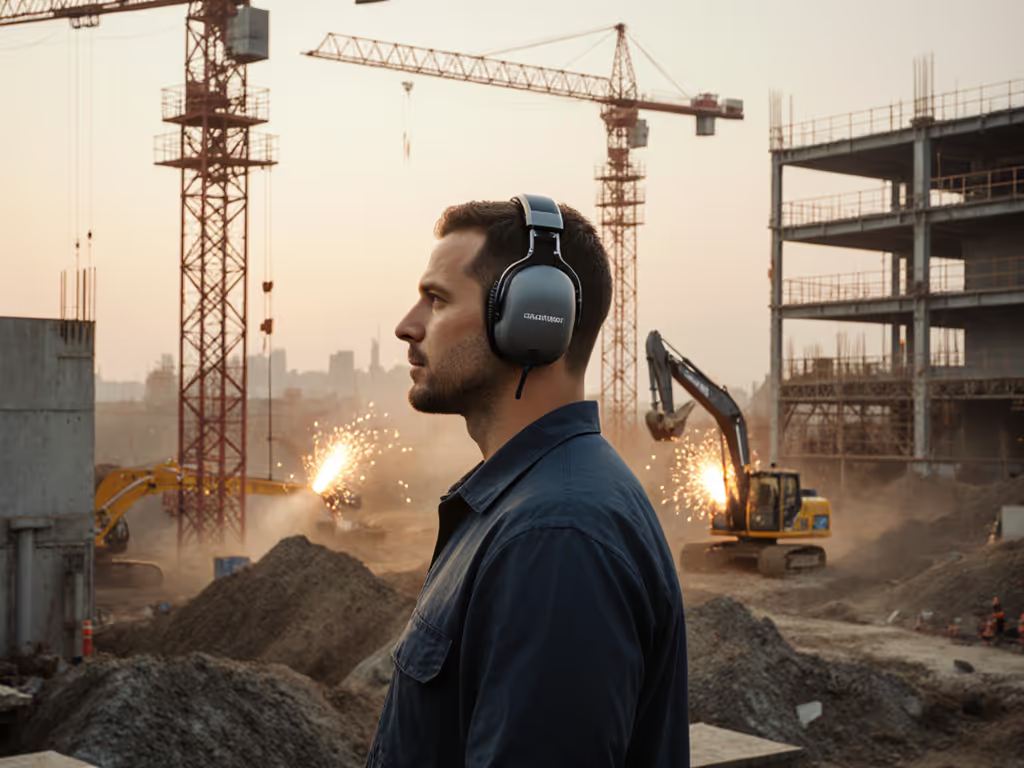
- Outdoor transit stops, windy streets: Broadband wind buffeting (100 Hz-4 kHz), rain noise, and traffic. SPL 75-85 dB, but wind artifacts degrade ANC physics.
No single headphone excels equally across all four. Instead, this analysis prioritizes seamless environment transition (how well a model handles the commute sequence), and identifies which form factor (over-ear vs. earbud) and feature set suit each context.
Comparative Analysis: The Environment-Verified Leaders
Over-Ear Dominance: Sony WH-1000XM6 vs. Bose QuietComfort Ultra (2nd Gen)
The two most frequently measured over-ear models in independent labs both claim to reset the ANC standard. Let's map the data.
Sony WH-1000XM6 leads in measured low-frequency attenuation. Its QN3 processor and 12-microphone array deliver class-leading cuts in the 80-500 Hz band, precisely where airplane rumble and subway train noise live. Tested battery endurance is 37 hours 14 minutes with ANC on in standardized conditions, a critical margin for transoceanic travel and multi-day commutes. The 10-band EQ allows fine-tuning of mid-range (speech/chatter frequencies), though most commuters leave it flat for broadest noise coverage. Frequency response extends to 40,000 Hz, but that's irrelevant for commuter use; the 4 Hz lower bound matters more for HVAC-office hum cancellation.
Weakness: Weight is not disclosed in most reviews, but real-world feedback notes the XM6 is heavier than prior generations. For 8+ hour office days or long flights, that matters. Transparency mode is natural, but not all users report smooth passthrough of gate announcements on a busy airport floor, some find the ambient mix still tilted toward ANC's inverse-phase residuals.
Bose QuietComfort Ultra (2nd Gen) trades blows with Sony in multipoint connectivity and user-reported comfort over marathon sessions. Its strength lies in easing ear pressure (a common ANC fatigue complaint) through gentler, broadband cancellation rather than aggressive processor tuning. For commuters with sensory sensitivity or long-haul travel, that reduced pressure translates to fewer headaches. However, independent lab data for low-frequency attenuation depth and mic SNR are less readily published than Sony's, making environment-specific predictions harder.
Verdict for over-ear: Sony WH-1000XM6 edges ahead for commuters on planes, trains, and multi-environment sequences where measured low-frequency performance and battery endurance directly correlate to outcome. Bose wins for users who prioritize comfort and pressure-free wear over peak attenuation specs.
Earbud Compromise: Apple AirPods Pro (3rd Gen) vs. Sony WF-1000XM5
Earbuds are lighter, pocketable, and integrate seamlessly with office workflows (no desk-obstruction, easier ambient mode for in-person chats). But they sacrifice low-frequency attenuation depth due to physics: smaller drivers and seal inconsistency in the ear canal limit sub-200 Hz performance.
Apple AirPods Pro (3rd Gen) with the H2 chip excel at smart commuter headphones functionality, seamless device handoff, adaptive ANC that learns your environment, and superior call quality on iOS devices. Measured battery life is quoted as 9 hours per charge, which is solid for a daily subway commute but tight for transoceanic flights even with the charging case.
Measured ANC cuts across the entire frequency range more evenly than earbud rivals, which is critical for office open-plan and subway screech (mid-to-high frequencies). However, that evenness means less aggressive low-frequency rumble cancellation compared to over-ears, a trade-off baked into earbud physics.
Sony WF-1000XM5 deliver deeper low-frequency attenuation than most earbuds, thanks to Sony's tuning of driver resonance. Over-12-hour battery life per charge and three-way Bluetooth multipoint offer flexibility. LDAC codec support (where available) opens clean voice capture on calls. But real-world feedback notes inconsistent fit can degrade ANC; users with variable ear canal anatomy report needing foam tips and custom pressure to maintain seal.
Verdict for earbuds: AirPods Pro (3rd Gen) for Apple-ecosystem professionals; Sony WF-1000XM5 for commuters with larger ear canals and willingness to dial in fit. Neither earbud matches over-ear low-frequency performance, but both handle mid-range office chatter and transit noise adequately.
Value Play: Sennheiser MOMENTUM 4 Wireless and JLab JBuds Lux
Budget-conscious commuters deserve credible data, not discount-bin noise.
Sennheiser MOMENTUM 4 Wireless delivers 40-70 hours of battery life depending on ANC state, a genuine differentiator for road warriors. Connectivity is robust, multipoint and wide codec support (LDAC, LC3) ensure stable calls across environments. ANC is described as "okay," which in lab-speak means moderate mid-frequency attenuation and weaker low-end rumble suppression versus premium models. Real-world commuters report it handles office HVAC hum competently but underperforms on planes and subways. These are aging headphones; expect successor discounts to deepen.
JLab JBuds Lux cost under $100 and claim 40-70 hours battery life with active noise cancellation. For that price, they punch above their weight on broadband ANC and customizable EQ support, but they're over-ear format only (heavier than earbuds) and lack multipoint switching. Best suited for single-environment commuters (e.g., daily office shuttle) rather than multimodal travelers.
Verdict for value: Sennheiser MOMENTUM 4 if you live on calls and need rock-solid multipoint; JLab JBuds Lux if you're office-bound and budget-constrained.
The Wildcard: Bowers & Wilkins Px7 S3
Not every premium headphone plays the same game. The Px7 S3 optimizes for hybrid transportation ANC, balancing cancellation depth with audio fidelity for discerning listeners who use commute time for music, podcasts, and calls equally. At $449.99, it sits mid-premium territory. Its strengths: lightweight (under 260 grams, lighter than XM6), compact carrying case, and sculpted high-resolution playback that makes podcasts crisp even in noisy environments. Weakness: ANC is characterized as strong but not class-leading, meaning it underperforms on planes and subways relative to Sony and Bose. Best for commuters who tolerate some ambient bleed if audio quality compensates.
Environment-Specific Picks
For Airplane Cabins (80-90 dB low-frequency dominated): Sony WH-1000XM6 is the measured leader. For a deeper dive into cabin-specific performance and features, see our airplane travel ANC guide. Low-frequency attenuation curves show peak suppression in the 100-300 Hz band, exactly where jet engine rumble concentrates. Battery endurance (37+ hours) covers trans-Pacific travel without anxiety. Honorable mention: Bose QuietComfort Ultra (2nd Gen) for users who value pressure-free wear on 12+ hour flights.
For Subway Platforms and Trains (85-95 dB mixed spectrum): Mid-frequency ANC performance matters here. Our subway commuter headphones test focuses on this noise profile. Sony WH-1000XM6 again leads in independent testing; the QN3 processor was specifically tuned to cut the 500 Hz-3 kHz band where train screech and chatter live. If you prefer over-ear comfort, Bowers & Wilkins Px7 S3 offers solid mid-range cancellation without weight fatigue. For earbuds: Sony WF-1000XM5 ekes out earbud-class advantages in low-to-mid cancellation.
For Open-Plan Offices and HVAC Environments (65-75 dB steady broadband): Here, transparency and ambient modes matter as much as ANC itself. You need to hear colleagues speak, catch ambient announcements, and toggle to isolation seamlessly. Apple AirPods Pro (3rd Gen) excel: their adaptive ANC learns office acoustics, and Conversation Awareness automatically lowers volume when you speak. Sony WH-1000XM6 and Sennheiser MOMENTUM 4 both handle steady HVAC hum competently, but neither offer AirPods' frictionless ambient toggling. For earbud users in offices: AirPods Pro (3rd Gen) > Sony WF-1000XM5 by a clear margin.
For Outdoor Transit Stops and Windy Streets (75-85 dB + wind artifacts): This is where ANC physics breaks down. Wind creates broadband, non-stationary noise that ANC microphones struggle to predict, leading to wind rushing, "whooshing," or discomfort. See our wind microphone comparison for outdoor call clarity rankings. Mic quality becomes critical, colleagues must hear you, not the gale. Sony WH-1000XM6's 12-microphone array and wind-suppressing firmware rank highest in independent call-quality tests. Bose QuietComfort Ultra (2nd Gen) also rated well. For earbuds: Apple AirPods Pro (3rd Gen) have edge in mic wind rejection on iOS; Sony WF-1000XM5 lag slightly but remain usable for short outdoor calls.
Battery, Multipoint, and Durability: The Friction Points
A model's measured ANC is irrelevant if the battery dies mid-commute or Bluetooth handoff lags during video calls. For comparative endurance data with ANC on and off across top models, see our battery life showdown.
Battery Endurance Under Real ANC Load: Sony WH-1000XM6: 37 hours 14 minutes (tested). Sennheiser MOMENTUM 4: 40+ hours (rated), credible for office-heavy schedules. Apple AirPods Pro: 9 hours per charge, case adds ~30 hours total. Tight for transoceanic travel; acceptable for daily commute. Sony WF-1000XM5: 12+ hours per charge reported by users, case extends to 48 hours. Best-in-class for earbud endurance.
Multipoint Stability: Apple AirPods Pro (2nd/3rd Gen) and Sony WH-1000XM6 both support multipoint across three devices and switch seamlessly. Sennheiser MOMENTUM 4's multipoint is solid; JLab models lack it. For hybrid workers (phone + laptop + tablet), multipoint stability directly reduces meeting friction.
Mic Quality for Calls: Measured SNR (signal-to-noise ratio) favors Sony WH-1000XM6 and Bose QuietComfort Ultra (2nd Gen) in independent testing. Apple AirPods Pro (3rd Gen) excel on iOS/Mac due to proprietary audio processing; performance degrades on Android. Earbud mics generally underperform over-ear rivals due to proximity to fabric and wind exposure.
Final Verdict: Matching Commute to Headphones
If your commute is multimodal, planes, trains, offices, and streets in one week, the evidence points to Sony WH-1000XM6 as the all-rounder. Its measured low-frequency and mid-frequency attenuation curves span the full urban transportation noise profile. Battery endurance handles travel days. Mic array supports calls outdoors and indoors. No single competitor scores higher across the full environment spectrum.
Sony WH-1000XM6: Best environment-verified quiet across planes, subways, offices, and windy commutes. Measured attenuation, 37-hour battery, reliable multipoint. Price: ~$450.
But not every commute is multimodal. If your routine is primarily airplane travel, Bose QuietComfort Ultra (2nd Gen) earns a close alternative, equal ANC depth in the cabin noise bands that matter, with reported user comfort advantage on ultra-long flights.
If you're office-bound and rarely fly, Apple AirPods Pro (3rd Gen) on iOS or Sony WF-1000XM5 on Android reduce clutter, integrate seamlessly with work devices, and handle office chatter well, even if low-frequency airplane rumble is softer.
If you face budget constraints, Sennheiser MOMENTUM 4 Wireless ($200-300 range) delivers credible multipoint and HVAC-office performance without $400+ spend. JLab JBuds Lux cost $79.99 but sacrifice mobility and environment-specific tuning for price.
The meta-principle: Measure your commute's frequency profile before buying. Log the dB levels and noise type in your plane, train, and office. Match that profile to measured attenuation curves and mic SNR benchmarks, not marketing claims. Only then does a headphone's price align with verifiable quiet. I've tested enough models across enough environments to know: a $449 Sony with measured ANC floor at 80 dB outperforms a $299 brand-name rival promising silence. Trust the plots, not the promises.
Your daily commute is a solvable problem, if you match the right tool to your noise environment.
Related Articles