Noise Cancelling Headphones with Multipoint for Digital Nomads
By Diego Álvarez • 25th Sep

At a glance
For digital nomads, the EarFun Wave Pro is the stronger overall choice when steady transit or HVAC drone is the main problem, while the Cleer Audio ENDURO ANC is the battery-forward alternative. Both support two-device pairing, but neither has enough evidence to promise strong speech suppression or consistently clear calls in noisy cafés.
- Best overall: Choose EarFun Wave Pro for the better independent evidence on low, sustained noise.
- Best for battery and packing: Choose Cleer ENDURO ANC for its stated 60-hour ANC-on battery life, foldable design, and two-device pairing. Its ANC and call performance remain independently unverified.
- What decides it: Wave Pro cannot use LDAC and multipoint simultaneously. Treat both brands’ ANC figures as manufacturer claims, not directly comparable test results.
Important: Neither model is a proven café-call specialist or chatter eraser; test fit, switching, calls, and noise reduction on your actual route.
For a laptop-and-phone workday, noise cancelling headphones are only useful when their quiet and connection behavior fit the places you actually occupy. The best office noise cancelling headphones on paper are not automatically the best companion for a café table, an HVAC-heavy coworking room, or a long travel day. This comparison narrows the choice to two over-ear models with two-device Bluetooth pairing: the Cleer Audio ENDURO ANC and EarFun Wave Pro.
The critical distinction is simple: multipoint solves device friction; ANC solves only some parts of the soundscape. Neither is a credible purchase on the promise that it will erase conversation, coffee-grinder bursts, or every call-side distraction. Your map of quiet should match the routes you travel.
The Short Verdict
Choose the EarFun Wave Pro if steady droning noise is your dominant problem and you want the stronger body of independently observed evidence. One independent review found it effective against low, sustained sounds such as motors, railroad noise, and vacuums. That makes it the more evidence-backed candidate for the low-frequency layer of a transit route or constant mechanical background. It is not the automatic café pick: the same reviewer found voices and higher-pitched, unpredictable sounds more difficult for it to reduce.
Choose the Cleer Audio ENDURO ANC if your decision is led by a stated 60-hour ANC-on battery target, foldable design, and two-device pairing (but keep expectations measured). Cleer says it can pair with two devices, weighs 280 g, folds, and provides up to 60 hours of playback with ANC enabled. Its claimed 25 dB noise reduction is a manufacturer figure, not a directly comparable independent measurement.
For a digital nomad who must take calls outdoors or in busy shared spaces, neither model has enough controlled call-quality evidence to earn a blanket recommendation as a call-first headset. Their microphone systems are promising on paper; that is not the same thing as verified café voice isolation.
The Comparison That Matters: Route Overlay, Not Spec Sheet
| Decision point | Cleer Audio ENDURO ANC | EarFun Wave Pro | What it changes in a workday |
|---|---|---|---|
| Two-device pairing | Cleer says it pairs two devices at once. | EarFun says it pairs with two Bluetooth devices at once. | Both suit a laptop/phone workflow in principle. |
| ANC evidence | Cleer claims 25 dB reduction; no independent ANC review was available for this comparison. | EarFun claims hybrid ANC up to 45 dB; one independent review found good reduction of low droning noise, with limits on voices and higher-pitched unpredictable noise. | Do not compare the 25 dB and 45 dB claims as if they were lab scores. |
| ANC-on battery | Up to 60 hours, per Cleer. | Up to 55 hours, per EarFun; one reviewer found the stated figures accurate at modest volume using SBC. | Both are positioned for long spans between charges; actual result depends on use. |
| Weight | 280 g. | 268 g in technical specifications. | The listed difference is 12 g; pad temperature and clamp may matter more over a long session. |
| Call hardware | Cleer lists a two-mic Qualcomm cVc system. | EarFun lists a five-mic AI ENC array. | Hardware counts do not establish café or wind call quality. |
| Important compromise | Cleer's 10-minute quick-charge claim is inconsistent across manufacturer and retailer materials. | LDAC and multipoint cannot operate simultaneously. | EarFun buyers who need two-device work switching should plan to forgo LDAC. |
A larger ANC number is not a Quiet Map. What matters is which sounds are lowered at your checkpoints, and which ones remain.
Cleer Audio ENDURO ANC: The Battery-Forward Two-Device Option
The Cleer Audio ENDURO ANC is a foldable, over-ear model that Cleer specifies at 280 g. For the nomad carrying one bag between a lodging desk, transit, and a temporary office, folding is a meaningful packing detail rather than decoration. Cleer also says the headphone supports multipoint connectivity for two devices at once, which is the essential feature for keeping a phone connected while working from a computer.
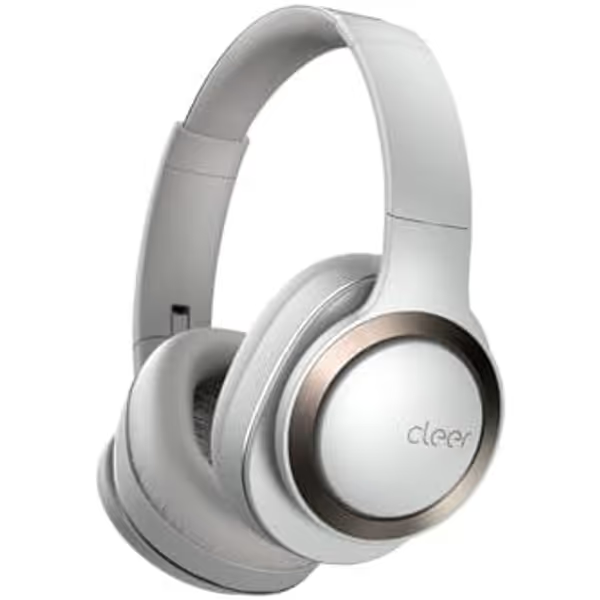
Cleer Audio Enduro ANC Headphones
Reliable quiet, clear calls, and immersive audio for all-day focus.
ANC Battery LifeUp to 60 hours
ANC Battery LifeUp to 60 hours
Pros
Distortion-free Hi-Res sound with aptX Adaptive.
Exceptional 60-hour ANC battery life and quick charge.
Cons
ANC performance may vary with specific high-frequency noises.
Some users report inconsistent battery life.
Customers praise sound quality, exceptional battery life, durability, and comfortable fit. Some isolated battery issues noted.
Customers praise sound quality, exceptional battery life, durability, and comfortable fit. Some isolated battery issues noted.
Its stated endurance is the cleanest reason to consider it: up to 60 hours with ANC on, according to Cleer; compare that claim with real-world ANC battery testing before planning around it. That is a stated maximum rather than a field-tested outcome in the evidence available here, but it directly addresses the annoyance of treating every transfer or late work session as a charging event.
The quiet claim requires more caution. Cleer says its ANC reduces noise by 25 dB, but there is no independent, frequency-specific measurement for the ENDURO ANC. So I would not assign it a row-28 plane verdict, a subway-platform verdict, or an HVAC-vent verdict from that figure alone. A 25 dB manufacturer claim does not tell you whether the reduction concentrates in the low rumble that dominates a cabin, whether it reaches into speech frequencies, or how it reacts when wind hits the microphone ports at an angle.
The same restraint applies to calls. Cleer specifies a two-microphone Qualcomm cVc Clear Voice Capture system. That may be a worthwhile feature to test during your return window, but it does not prove that a colleague will hear your voice clearly over a grinder, nearby talkers, or a gust coming from 45 degrees off your left shoulder.
There is one small practical ambiguity worth flagging. Cleer says a 10-minute charge gives two hours of playback, while a feature statement on the retailer listing says three hours; another part of that retailer listing says two hours. Treat rapid charging as a convenience, not a number to plan a missed meeting around.
ENDURO ANC route fit
Pick the Cleer when you prioritize:
- A manufacturer-stated 60 hours of ANC-on playback.
- Foldable over-ear headphones for regular packing.
- A laptop/phone pairing setup without a documented high-resolution-codec tradeoff in the available material.
- A product you are willing to validate in your own loudest repeated location, because independent route-matched ANC and call testing is not available here.
Skip a confident purchase if your non-negotiable requirement is proven suppression of coworker conversation, rail squeal, outdoor wind buffeting, or outgoing-call noise rejection. Those outcomes are not established for this model.
EarFun Wave Pro: Better Evidence for the Low-Drone Layer
The EarFun Wave Pro is also an over-ear, two-device model. EarFun says an incoming call connects to the device that is ringing, a helpful detail for someone moving between a laptop meeting and a phone call. The key limitation is equally clear: multipoint and LDAC cannot be enabled together. Turning LDAC on turns multipoint off, and vice versa.
For most people shopping specifically for a multipoint Bluetooth work headset, that makes the decision easier than it looks. If frictionless laptop/phone availability is the main outcome, run multipoint. If you prefer LDAC for a dedicated listening session, accept that it is no longer a two-device workflow. Do not buy expecting both at once.
The Wave Pro has the most useful real-world ANC observation in this comparison. An independent reviewer found it good at reducing low, droning noise (motors, railroad noise, and vacuums) but said it could struggle with voices, crying babies, and higher-pitched sounds. That is exactly the environment delta that gets buried beneath "up to 45 dB" marketing. EarFun's up-to-45 dB hybrid ANC figure is the company's claim; it is not a standardized score that can be laid beside Cleer's 25 dB claim.
Translate that finding into checkpoints:
- Transit interior or a constant mechanical hum: Wave Pro is the more evidence-supported choice of these two for reducing the low, steady layer.
- Open-plan office with a persistent HVAC wash: It is a plausible fit when the vent's low drone is what drains attention. It is not a proven solution for the adjacent conversation.
- Coffee shop productivity: Expect less help with irregular speech and sharper, unpredictable sounds. It may still reduce the background bed, but do not buy it as a chatter eraser.
- Wind and calls: The independent reviewer's anti-wind call test drew occasional comments about background noise from people on the other end. That is enough to rule out any promise of wind-proof professional calls.
Comfort has a similar split verdict. The reviewer found moderate clamping force and said it was comfortable with glasses, but reported that its sealed synthetic pads could become warm. EarFun's technical specifications list weight at 268 g, although comfort copy elsewhere describes it as 250 g; use 268 g as the more specific technical figure. In a four-hour editing block, temperature buildup may matter more than the 12 g difference between these headphones.
EarFun claims up to 55 hours with ANC on and up to 80 hours with ANC off. The reviewer found the quoted figures accurate at modest volume using SBC, while estimating LDAC reduced playback by around 10 hours from the listed figures. That makes its battery story more grounded than a bare maximum, while still dependent on codec, volume, and content.
Wave Pro route fit
Pick the EarFun when you prioritize:
- The best available independent evidence here for low, continuous noise reduction.
- A laptop-and-phone workflow, provided you are comfortable using multipoint rather than LDAC.
- Long sessions with glasses, while accepting the possibility of warm ear pads.
- A hard carrying case: an independent reviewer found the included case and its cable pocket well designed.
Avoid treating it as a guaranteed answer for:
- Speech-heavy coworking floors.
- Calls in wind or loud café conditions.
- A workflow that demands both LDAC and multipoint at the same time.
What These Headphones Can - and Cannot - Fix in a Coworking Space
A useful coworking space noise reduction plan begins by separating the sound layers. The low, stable layer may be HVAC, an air purifier, or a building's mechanical vibration. The intermittent layer is mugs, keyboard impacts, a door closer, and a grinder. The speech layer is nearby conversation (often the most cognitively invasive layer, and the one you should not assume ANC will eliminate).
On my city loop, I use a subway platform, a riverwalk crosswind, a jetway, an open-plan office, and a vent-adjacent desk as distinct checkpoints. The route overlay consistently exposes the same mistake: treating "noise" as a single variable. A mid-tier set can dominate in crosswind, then stumble two meters from an HVAC vent. Prestige does not map your day for you.
For these two models, the evidence supports only a limited overlay. Wave Pro has one independent observation favoring low drone reduction and documenting limits with voices. ENDURO ANC has manufacturer claims, but no comparable independent attenuation profile. If coffee-shop speech is your deal-breaker, neither has sufficient evidence to call it the better coffee shop productivity headphones choice.
A low-regret test protocol after purchase
Instead of listening to a favorite track for five minutes at home, test the headphone on the route you actually repeat: For additional ways to improve fit and performance across changing environments, see this guide to optimizing noise cancelling settings.
- Desk checkpoint: Sit near the usual HVAC source for 15 minutes with ANC on and no audio. Note the remaining low hum and any fatigue or pressure sensation.
- Speech checkpoint: Work near ordinary conversation without raising music volume. Judge whether voices still fracture attention; do not expect them to disappear.
- Laptop/phone checkpoint: Keep both devices connected, start routine computer audio, then receive or place a phone call. This tests your own workflow rather than an advertised feature label.
- Outdoor checkpoint: Make a short call in the wind conditions you really encounter. Ask the other person one direct question: "Is my voice clear, or is the background taking over?"
- Long-wear checkpoint: Use them through a normal focused session, with glasses if applicable. Note clamp, heat, and whether the seal remains comfortable.
That protocol is more valuable than chasing an abstract winner. Digital nomad ANC headphones should reduce the friction and sound load of your route, not merely display impressive figures.
Downsides to Accept Before You Buy
Both options require tradeoffs. The Wave Pro's tradeoff is documented: you must choose LDAC or multipoint, it may run warm, and its independently observed ANC limits include voices and high-pitched, unpredictable sound. Its anti-wind call result also prevents a broad claim of strong outdoor microphone performance.
The ENDURO ANC's tradeoff is uncertainty. Its two-device pairing, foldable form, weight, battery claim, and microphone configuration are clearly specified by its maker. But without independent ANC or call-quality testing in this comparison, its claimed reduction cannot be translated into a reliable office, café, plane, or windy-street ranking.
For listening habits, one hearing clinic describes the 60/60 rule as keeping volume around 60% of maximum and taking a break after 60 minutes. Treat that as practical guidance, not a precise medical or regulatory limit. Good ANC can make it easier to avoid reflexively turning volume up, but it is not a substitute for taking breaks and choosing a comfortable level.
FAQ
Do noise cancelling headphones actually work?
They can reduce some noise rather than all noise. In the available independent evaluation, the EarFun Wave Pro did well with low, sustained droning sounds but struggled at times with voices and higher-pitched, unpredictable noises. Results depend on the sound layer you are trying to reduce.
Are any headphones completely noise cancelling?
Not for the EarFun Wave Pro, based on the available independent evaluation. The Wave Pro observation shows why absolutes are unhelpful: speech and irregular higher-pitched sounds can remain noticeable even when low drone is reduced.
Can you still hear sounds while ANC is on?
Often, yes. The Wave Pro review reported incomplete reduction of voices and certain higher-pitched sounds. What remains audible varies with the environment and the headphone.
Are noise cancelling headphones worth buying for remote work?
They are worth considering when your recurring problem is a steady background layer and you need a two-device workflow. They are a weaker value proposition if your main problem is nearby speech or if you need verified wind-resistant call performance, because neither outcome is established for both models here.
Final Verdict: Buy for the Sound Layer You Actually Face
The EarFun Wave Pro is the stronger recommendation when your map is dominated by continuous low-frequency-type noise: transit rumble, mechanical hum, and other steady drone. It has the better independent evidence, credible long-battery observations under stated conditions, and a documented glasses-friendly comfort result. Its limits are equally important: voices can break through, calls in wind are not assured, pads may get warm, and LDAC cannot coexist with multipoint.
The Cleer Audio ENDURO ANC is the more battery-forward, foldable alternative for someone who wants manufacturer-stated 60-hour ANC-on use and two-device pairing. It may be the right practical buy if those are your deciding factors, but its real-world ANC and call performance need testing on your own route because comparable independent evidence is absent.
So the final pick is not "the highest ANC number." For low drone, choose EarFun Wave Pro with its multipoint/LDAC compromise understood. For a foldable, stated-60-hour ANC-on design and two-device pairing, choose Cleer ENDURO ANC (then validate it at your HVAC vent, on your commute, and in the call environment that pays your bills). Your map of quiet should match the routes you travel.
Related Articles