ANC Headphones for Big Heads: Low Clamp Comfort Showdown
By Amara Singh • 10th Sep
Quick verdict
For big-head comfort, the Bose QuietComfort 45 is the better-supported choice: Bose describes minimal clamping force, and one reviewer found minimal pressure and ample earcup space. The Sony WH-1000XM5 is not proven uncomfortable, but its large-head fit is less documented and carries more uncertainty.
- Choose the QC45 if: Low pressure and longer sessions are your priorities. Its comfort case has both manufacturer positioning and independent qualitative support, though neither provides a clamp-force measurement. View on Amazon
- Choose the XM5 if: You prefer it for other reasons and can test it under a flexible return policy. Pay particular attention to crown pressure, glasses comfort, and whether discomfort develops during a full-hour session.
- Main trade-off: QC45 has stronger fit evidence, while XM5 remains less measured rather than definitively worse.
Important: The QC45 listing considered here is Renewed, so verify its condition, warranty, hygiene details, and return terms before deciding.
Shopping for ANC headphones for big heads is frustrating because "comfortable" is often treated as a vibe rather than a fit outcome. For this two-model comparison, the defensible result is narrow but useful: the Bose QuietComfort 45 has materially stronger evidence as a low-pressure candidate than the Sony WH-1000XM5. That does not prove it will fit every large head, because the collected sources do not provide clamp-force figures, maximum headband-extension measurements, or comparable earcup-depth dimensions for the two models.
That distinction matters. A headphone that feels fine for a 20-minute demo but creates temple or crown pressure by hour two has poor value, regardless of its logo. Spend for quiet, not for logos or launch hype.
1. Start with the fit evidence, not the word "ANC"
For larger heads, the practical comfort equation has three parts. Our noise-cancelling headphone comparison provides useful context on the broader comfort and noise-isolation trade-offs between form factors.
- Side pressure: Does the frame feel squeezed at the jaw, temples, or above the ears?
- Crown loading: Does the top band concentrate weight in one painful spot?
- Earcup accommodation: Do your ears sit inside the pads without rubbing, especially with glasses?
A true low clamp force ANC comparison would publish force measurements taken under the same conditions. This one cannot: the collected sources provide no clamp-force value for either headphone. Likewise, the collected sources provide no headband-range, interior cup width/height, or cup-depth figures that would let you calculate a reliable "large-head fit range."
So the right approach is to weigh the available evidence. Manufacturer language is useful but not the same as a lab measurement. A reviewer's long-session impression adds practical context but remains subjective. One owner's bad experience can flag a risk, but it cannot describe everyone's fit.
Best value is verified value.
For buyers trying to avoid another return, that means selecting the pair with the better-supported comfort case, then validating it with your own head shape, glasses fit and seal integrity, and longest normal session.
2. Bose QuietComfort 45: the better-supported low-pressure option
Bose describes the QuietComfort 45 as having minimal clamping force, along with smooth earcups. It also says the ear cushions and the top of the headband use plush synthetic leather. Those are manufacturer statements, not numeric fit measurements (but they point in the right direction for someone who routinely feels squeezed by headphones).
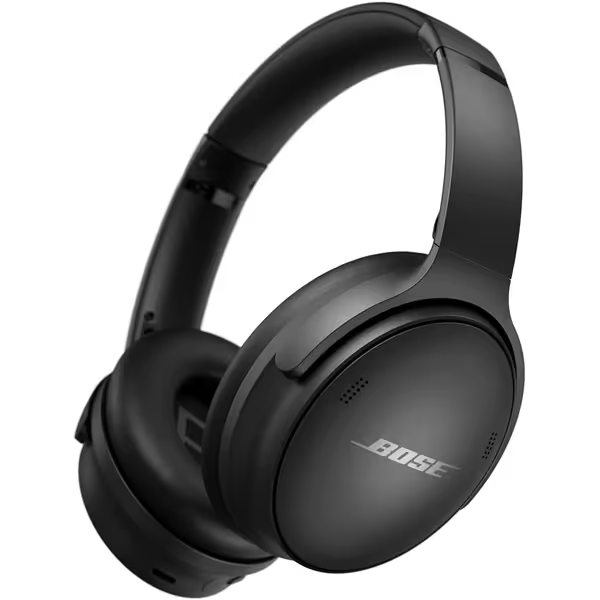
Bose QuietComfort 45 Renewed
Balanced quiet, comfort, and sound for all-day wear.
$146.89
Battery LifeUp to 24 hours
Battery LifeUp to 24 hours
Pros
Exceptional comfort for long sessions
Rich, balanced audio with Active EQ
Cons
Inconsistent ANC performance reports
Durability and reliability concerns
Customers find these headphones extremely comfortable and worth their price, with good sound quality and amazing battery life. The noise cancellation receives mixed reviews - while some praise its effectiveness, others report it being virtually non-existent. Moreover, functionality and durability are concerns, with some units stopping working and breaking within 10 months of use.
Customers find these headphones extremely comfortable and worth their price, with good sound quality and amazing battery life. The noise cancellation receives mixed reviews - while some praise its effectiveness, others report it being virtually non-existent. Moreover, functionality and durability are concerns, with some units stopping working and breaking within 10 months of use.
There is a useful independent corroborating signal. One reviewer measured the QuietComfort 45 at 235.4 g and characterized it as having ample interior earcup space and minimal pressure. The reviewer did not provide cup dimensions or a clamp-force test, so do not treat those descriptions as guarantees. Still, this is more relevant evidence than a generic claim that a pair is "lightweight." For additional perspective on pressure points, heat buildup, and extended wear, see our long-session ANC comfort testing.
What that means for a large-head buyer
The QC45 has the strongest available case if your main problem is pressure accumulation over several hours. The signals align:
- Bose positions it around minimal clamping force.
- An independent reviewer found minimal pressure.
- That reviewer also found ample earcup interior space.
- Its measured weight was 235.4 g in that review.
Weight is not clamp force, and a 235.4 g headphone can still fit badly on a particular head. But weight per hour of use matters once the band is already pressing down. Less mass does not solve a narrow headband or shallow pads; it simply gives your comfort system less load to manage.
The exact retail option considered here is a Renewed QC45. That can alter the lifetime-cost calculation: verify the listing-specific condition, return terms, warranty coverage, and hygiene details before buying. A low upfront cost is not automatically low cost per hour if the pads, battery, or return process create friction later.
For travel, the official owner's guide also says the QC45 earcups rotate inward to lie flat for storage. That is a packing convenience, not proof that the earcups articulate more effectively on your head.
3. Sony WH-1000XM5: insufficient fit data, plus one cautionary report
The Sony WH-1000XM5 is a noise-cancelling model, but the collected record is much thinner on the exact question that matters here: whether it accommodates a broad or large head with low clamp and comfortable crown distribution.
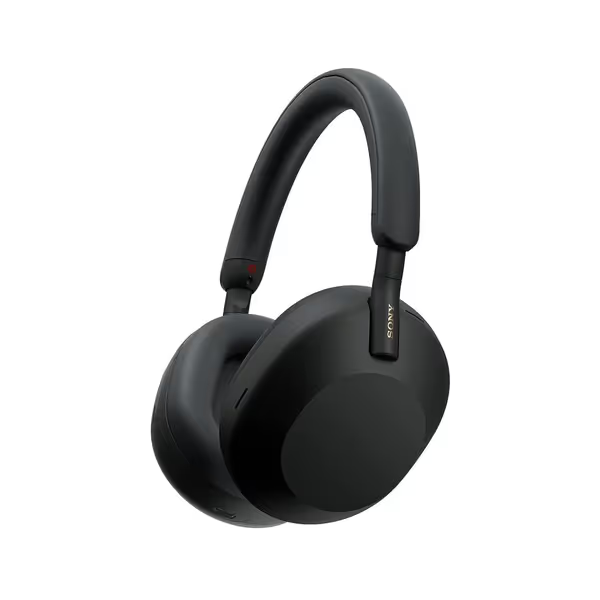
Sony WH-1000XM5 ANC Headphones
Superior noise cancellation for clear sound and calls in any environment.
$363.69
Battery Life30 Hours (3 min charge for 3 hrs playback)
Battery Life30 Hours (3 min charge for 3 hrs playback)
Pros
Exceptional noise cancellation, great for plane, subway, office.
Crystal-clear hands-free calls even in loud environments.
Cons
Inconsistent connectivity and power-off issues reported.
Durability concerns, especially with swivel hinge.
Customers praise these headphones for their phenomenal sound quality, superb noise cancellation, and comfortable design with larger ear cups. The functionality and connectivity receive mixed reviews.
Customers praise these headphones for their phenomenal sound quality, superb noise cancellation, and comfortable design with larger ear cups. The functionality and connectivity receive mixed reviews.
One reviewer's comparison list reported a tested weight of 245.9 g for the WH-1000XM5. That is 10.5 g above the same reviewer's reported QC45 weight. It is a small difference and should not be exaggerated into a comfort verdict. Headband geometry and pressure distribution can easily matter more than 10.5 g.
The more important limitation is missing evidence. The collected sources include no Sony manufacturer fit documentation and provide no numeric clamp measurement, maximum-extension measurement, earcup-depth measurement, or controlled large-head wear test.
One owner did report that the top band became painful after roughly an hour and that glasses made the experience worse. Treat that correctly: it is a single person's account, not representative evidence that the XM5 is uncomfortable, unsuitable for glasses, or a poor pick for all larger heads. It does, however, identify the exact failure mode a big-head shopper should test before committing: crown hot spots and glasses-related seal or pressure issues.
What that means for a large-head buyer
The XM5 is not disqualified. It is simply the higher-uncertainty choice for this specific brief. If you can try it under a solid return policy, do not evaluate it standing still in a store. Wear it while seated at your desk, with your usual glasses if applicable, for the kind of session you actually need it to survive.
This is where noise-cancelling headphones can become false economy. A pair may have features you want, but if it triggers a crown-pressure deadline at 60 minutes, its usable hours shrink. The monthly ROI is not the purchase price divided by the feature list; it is the cost divided by the hours you can wear it comfortably in your real routes.
4. The comfort scorecard: what this showdown can and cannot decide
Here is the clean comparison without pretending the missing measurements exist.
| Comfort factor | Bose QuietComfort 45 | Sony WH-1000XM5 | Practical read |
|---|---|---|---|
| Published numeric clamp force | Not reported in collected sources | Not reported in collected sources | No numerical winner |
| Low-clamp positioning | Bose says minimal clamping force | No comparable collected documentation | QC45 has better support |
| Independent pressure assessment | One reviewer described minimal pressure | No comparable reviewer assessment in the collected sources | QC45 has better support |
| Interior earcup assessment | One reviewer described ample interior space | No comparable dimensions or assessments in the collected sources | QC45 has better support |
| Reported tested weight | 235.4 g from one reviewer | 245.9 g from the same reviewer's comparison list | Small QC45 weight advantage only |
| Glasses-specific evidence | No controlled glasses test in the collected sources | One owner said comfort was worse with glasses | XM5 has an anecdotal caution, not a general verdict |
| Headband extension and cup depth | Not reported in collected sources | Not reported in collected sources | Try-before-you-keep is essential |
This table is intentionally not an ANC-performance ranking. It focuses on comfort evidence rather than ANC performance, so it does not rank either model for airplanes, subways, offices, or windy streets.
5. Use a 60-minute fit protocol before the return window closes
A broad-fit headphone claim is only valuable if the headset works on your head. Use a repeatable home test rather than relying on the first five minutes.
Step 1: Set the headband normally
Extend each side only as much as needed to center the earcups. Do not force the band wider than normal use just to see whether it can be stretched. You are testing comfort, not conducting a durability experiment.
Step 2: Check the seal without over-tightening
Put on the headphones as you would for work or travel, and consider whether ANC accessories that improve seal quality could address minor gaps without forcing the headband tighter. Note whether the pads rest evenly around your ears and whether any part of the cup presses directly on cartilage. If you wear glasses, repeat the check with them on.
Step 3: Wear them for a real hour
Use the pair for a meeting, study block, or commute-length listening session. At 15, 30, and 60 minutes, ask:
- Is side pressure increasing at the temples or jaw?
- Is the top of the band creating a single hot spot?
- Are my ears rubbing the inner walls of the cups?
- Do glasses noticeably worsen pressure or comfort?
- Do I feel relief the moment I remove the headphones?
That last question is often the most honest one. Comfort that requires repeated "micro-breaks" is not all-day comfort.
Step 4: Repeat on a second day
A single session can be misleading. Hair, posture, temperature, and fatigue change perception. Two or three ordinary work sessions expose whether the fit remains neutral or compounds into distraction. If the fit is comfortable but ANC still seems inconsistent, our guide to optimizing noise cancellation through fit and settings can help separate a setup issue from a hardware limitation.
Step 5: Make the purchase decision on usable hours
Do not turn a headphone into a sunk-cost project. If a pair is uncomfortable in your normal use case, return it within the applicable policy rather than hoping you will adapt. When I mapped a week of bus, subway, and bridge noise against actual spending, the cheaper winner was the one I could use without fighting it at every stop. The same principle applies here: your fit determines whether ANC is available when you need it.
6. Final verdict: which is the safer buy for big heads?
Among these two ANC headphones for big heads, the Bose QuietComfort 45 is the better-supported low-clamp choice. Bose explicitly describes minimal clamping force, and one independent reviewer separately described minimal pressure and ample interior earcup space while reporting a 235.4 g measured weight.
The Sony WH-1000XM5 remains an uncertain fit proposition, not a proven bad one. Its reported 245.9 g weight is only modestly higher in the available comparison, but the collected material does not provide comparable fit measurements or Sony official physical-fit documentation. One owner's report of crown pain and worse comfort with glasses is a reason to test carefully (not a reason to generalize).
If low clamp and long-session wearability are your non-negotiables, choose the QC45 first, provided the listing condition and return coverage make sense for you. If you prefer the XM5 for other reasons, buy only where you can run the 60-minute protocol with your own glasses and work setup.
The winning headphones are not the ones with the loudest comfort marketing. They are the ones that deliver quiet without making you count the minutes until you can take them off.
Related Articles