Home Office ANC Comparison: Real Household Noise
By Amara Singh • 7th Mar
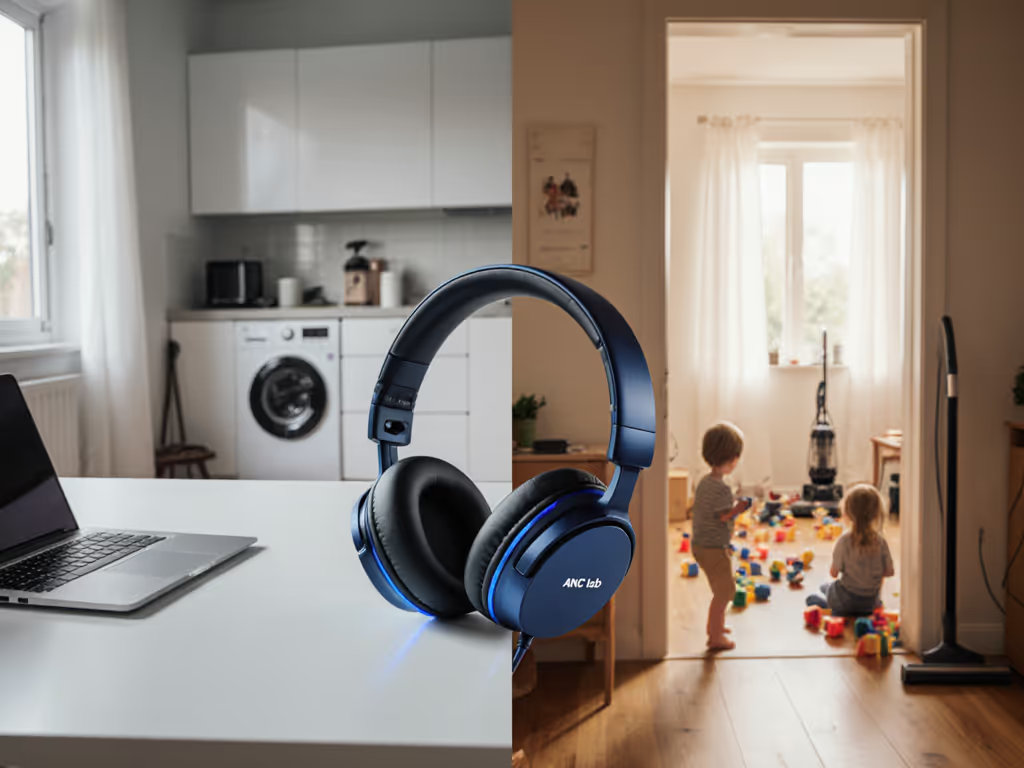
The promise of home office ANC sounds simple: put on headphones, block the world out, return to focus. The reality is messier. Unlike airports or subway platforms (where noise arrives in steady, predictable rumbles), a home office throws intermittent interruptions at you: a child calling your name, a delivery truck idling outside, the HVAC system cycling on mid-sentence, a barking dog, keyboard clatter from a spouse working nearby. These aren't the low-frequency hums that modern office noise canceling headphones excel at suppressing. They're erratic, often mid-to-high frequency, and they spike unpredictably. Most commercial ANC headphones are engineered for commute scenarios (planes, trains, consistent background drones). If office productivity is your priority, see our best office headphones guide for models tuned to desk work and calls. When you bring them home, the mismatch between design and reality becomes apparent: a $350 flagship that crushes airplane cabin noise may struggle with the exact frequencies your household emits.
Choosing the right ANC solution for a home office requires abandoning the one-size-fits-all rankings and asking instead: What does your noise actually sound like, and which cancellation architecture handles it best? More importantly, at what cost per decibel of quiet do you get there?
The Home Office Noise Profile: Where Standard ANC Falls Short
When I spent a week mapping commute noise across multiple transit routes (buses, subways, wind-exposed platforms), I tracked frequencies, consistency, and impact on focus. What struck me afterward wasn't the extremes; it was how little overlap existed between peak commute frequencies and the noise I encounter during a typical WFH day. A subway rumble sits around 60-100 Hz and hammers relentlessly. A home HVAC system behaves similarly at startup, then fades into near-silence. But a child's voice mid-meeting? That peaks around 200-500 Hz. A dog bark can spike to 1,000+ Hz. Keyboard clicks and mouse movements occupy similar territory. For a breakdown of which headphones tame low, mid, and high-frequency intrusions, see our frequency-specific ANC guide.
Most flagship ANC headphones (including the Sony WH-1000XM6, cited as a leading choice for office work[3]) excel at attenuating low-frequency rumble but offer diminishing returns as frequency rises[2]. This is physics and economics combined: canceling lower frequencies requires larger acoustic chambers and more processing power relative to the task. Canceling speech and intermittent high-frequency noise is harder, requires tighter adaptation loops, and draws more battery. For a home office, this architecture mismatch means you're paying for capabilities that won't fire when you need them most.
The second complication is intermittency. Airplane ANC assumes continuous input, the background hum never stops. Home offices introduce silence broken by noise spikes. To dial in fit and settings for jumpy environments, follow our ANC optimization guide. A well-tuned ANC loop that adapts to steady-state conditions can sound unnatural or even amplify faint sounds when the reference signal vanishes. Parents working from home with young children, in particular, often report that ANC creates a disconcerting effect. We tested models against real family household noise in our family home office ANC review.
Related Articles