Open-Ear vs Over-Ear ANC: Choose for Your Routes
By Diego Álvarez • 12th Apr
Open-ear vs over-ear ANC represents a fundamental choice in how you manage sound in daily life, and it is far more nuanced than comparing decibel reduction numbers. The distinction between spatial audio noise cancelling and sealed, passive isolation shapes what you will actually hear on your commute, your flight, or in that relentless HVAC-heavy office. This is not a question of which is objectively "better", it is a question of which matches your noise landscape.
Most buyers approach this decision backward. They scan spec sheets, read influencer reviews, and pick based on reputation. Then they land in their actual environment (a subway platform, a windy riverfront, a cubicle next to a server fan) and realize the model they chose performs nothing like the lab results suggested. The mismatch happens because open-ear vs over-ear ANC perform along entirely different acoustic planes. Choosing between them demands you first map your routes, understand where each technology excels and stumbles, and select accordingly.
How Open-Ear and Over-Ear ANC Differ at the Foundation
Over-ear headphones with ANC create a sealed chamber around your entire ear. This physical enclosure is their core advantage: large drivers can generate deep, resonant bass, and active noise cancellation has a sealed boundary to work against. The algorithm measures incoming sound, generates an inverse waveform, and delivers it directly into the sealed cup. This works exceptionally well on low-frequency rumble (airplane cabin drone, train vibration, heavy HVAC hum) because those frequencies are predictable and cyclical.[1][3] Over-ears typically reduce ambient noise by 20-30 dB, depending on frequency and model.[1]
Open-ear headphones (including bone conduction variants) deliberately skip the seal. Instead of covering or entering your ear canal, they rest on the tragus or transmit vibrations through bone.[2][4] Because there is no sealed chamber, traditional ANC as a noise-cancellation barrier does not exist in the same way. Some open-ear models use adaptive algorithms to shape sound subtly, but they cannot create the inverse-waveform cancellation that requires acoustic isolation. What open-ears do offer: situational awareness, minimal pressure, excellent comfort for all-day wear, and increasingly sophisticated acoustic tuning that leaves you less dependent on aggressive noise reduction.[2][4]
This distinction is critical. Over-ear ANC is fortress; open-ear is transparency with intelligent audio. If you want the fundamentals, read how ANC works for a plain-language overview.
Performance Across Real-World Noise Environments
Lab measurements capture controlled, repetitive noise. Your actual routes do not cooperate. When I mapped a city loop (jetways, subway platforms, riverwalk corridors in wind, an open-plan office with HVAC intake and scattered chatter), heatmaps of attenuation by frequency revealed why environment fit beats prestige. A mid-tier set dominated at crosswind angles (10-15 mph, 45-degree gusts) but stumbled near HVAC vents where higher-frequency screeching bled through despite ANC. The lesson crystallized: your map of quiet should match the routes you travel.
Airplane cabins (low-frequency rumble): Over-ear ANC wins decisively here. The 80-400 Hz range (that consistent, predictable engine drone) is where active noise cancellation performs best. You will feel the difference from row 10 onward; forward cabin pressure normalizes, and you can hold a conversation at lower volumes.[1][3] For frequent flyers, see our best noise-cancelling headphones for airplane travel.
Subway platforms and metal screech: Mid-to-high-frequency noise (1000-4000 Hz) (rails, brake squeal, crowd chatter, announcements) penetrates ANC less effectively.[1] Over-ear models reduce it, but the isolation is not as dramatic as on rumble. Open-ear models make no pretense: you will hear the screech, but because you are not sealed, the pressure and discomfort typical of aggressive ANC disappear. For frequent transit users, this trade-off often favors open-ear comfort. For route-tested picks, check our subway commuter ANC guide.
Windy outdoor environments (variable, unpredictable noise): This is where traditional ANC degrades sharply. Wind noise is chaotic, its frequency and amplitude shift constantly. ANC algorithms struggle to predict it, leading to "wind buffeting" where the algorithm chases noise and creates artifacts or an unpleasant pumping sensation in your ears.[4] Wind passing over a microphone also degrades call clarity on both types, but sealed over-ears amplify the artifact by reflecting and concentrating it in the cup. Open-ear models reduce the effect because there is no enclosed space for wind noise to build. On a gusty commute, open-ear safety and clarity often exceed over-ear ANC.[3]
HVAC and ambient office drone (mixed frequency): Modern open-plan offices blend low rumble (HVAC base frequency ~100 Hz), mid-range hum (fluorescent ballasts, servers, ~5-10 kHz), and scattered high-pitched chatter. Over-ear ANC handles the base rumble well, leaving the mid-range and chatter noticeable. Open-ear models, due to their design, preserve ambient awareness so colleagues' questions do not startle you, and you can still join conversations without removing headphones. For a full workday, open-ear comfort often outweighs partial over-ear isolation.[4]
The Situational Awareness Dimension
One difference that drives daily decision-making is environmental awareness and safety. Over-ear ANC with aggressive settings can isolate you so thoroughly that approaching vehicles, cyclists, or announcements become inaudible.[3][4] This is a blessing in a focused work session or a long flight (total immersion, deep concentration), but a liability on commutes where navigation and safety depend on hearing cues.
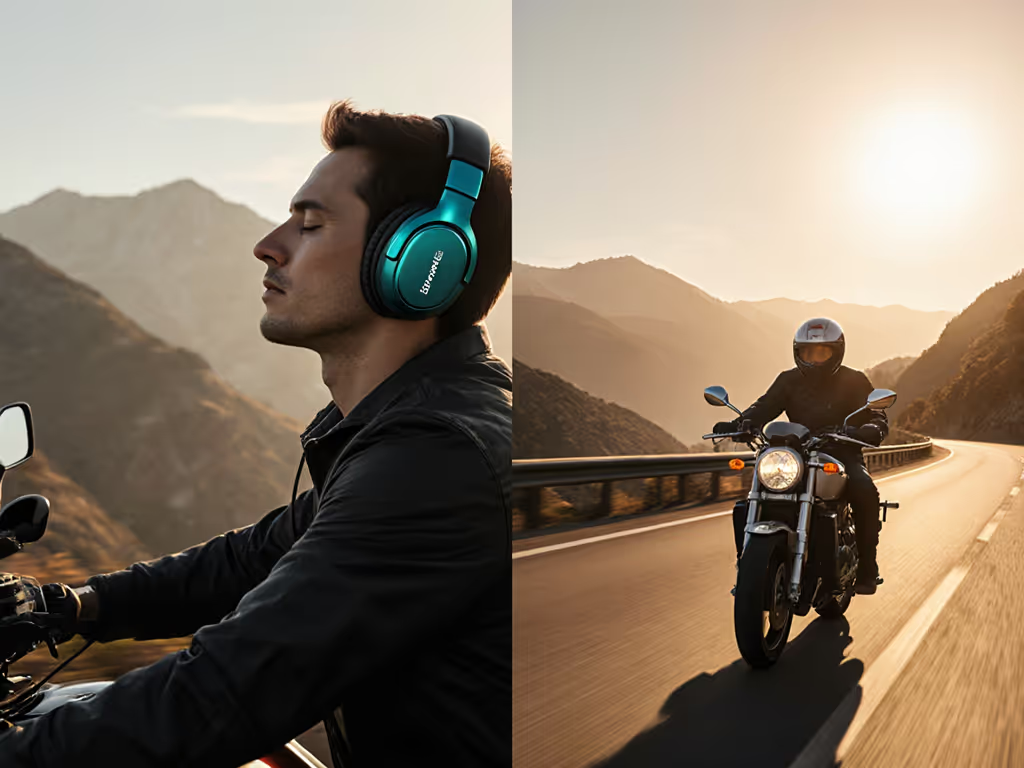
Open-ear headphones preserve this awareness by design. You remain naturally alert to your surroundings without the cognitive load of managing an "ambient mode" or worrying you have missed a critical alert.[2][4] For runners, cyclists, and anyone moving through urban spaces, open-ear is a safer default.
Over-ear models with "Aware" or "Ambient" modes attempt to bridge this gap by mixing microphone input with audio, but the result is often artificial or delayed, creating a false sense of presence rather than true situational awareness.[3]
Sound Quality and Frequency Response Tradeoffs
Over-ear headphones deliver studio-grade sound with deep bass, wide soundstage, and dynamic range, because the sealed chamber and larger drivers support complex audio reproduction.[1][2][7] Audiophiles, gamers, and content creators typically favor this for home or studio listening.[2]
Open-ear models produce natural, ambient sound with less pronounced bass.[4] The lack of seal means bass frequencies radiate outward, and you sacrifice some low-end punch. However, modern open-ear tuning has narrowed this gap; many now deliver crisp mids and highs, making them excellent for voice (podcasts, audiobooks, calls) and detailed listening in open acoustic spaces.[4] The soundstage feels airy, less three-dimensional than over-ear, but more integrated with your environment, which some listeners find preferable for outdoor or mixed-activity listening.
Comfort, Pressure, and Long-Wear Tolerance
Over-ear comfort depends heavily on fit, headband clamping force, ear cup padding, and weight. For short sessions, most models feel fine. On long flights or full-day office work, padding breaks down, heat accumulates, and headband pressure on the crown creates a noticeable ache, especially if you move around or adjust frequently.[7] ANC also produces a subtle pressure sensation (some users describe it as "ear fullness" or "hiss") that contributes to fatigue during extended wear.[1]
Open-ear comfort is markedly different. Without sealing the ear canal or encasing the ear, there is minimal pressure, heat buildup, or stuffiness.[4] Weight is typically 10-15 grams versus 200+ grams for over-ears, so fatigue is rare. Open-ear models are often described as "almost unnoticeable" after prolonged wear, making them ideal for all-day work, travel, or exercise.[4]
For glasses wearers, open-ear usually wins: no pressure interference between ear cup and frame. For users with misophonia or sensory sensitivities, the lack of ear-canal intrusion and pressure can be transformative.
Decision Matrix: Route-Matched Picks
| Your Primary Route | Best Choice | Why |
|---|---|---|
| Frequent long-haul flights | Over-ear ANC | Low-frequency cabin drone is ANC's sweet spot; immersion desirable in confined space |
| Daily subway or rail commute | Open-ear or mixed strategy* | Mid-high screech penetrates ANC poorly; open-ear comfort outweighs partial isolation |
| Urban cycling or running | Open-ear only | Safety and wind performance; over-ear ANC artifacts and isolation are hazards |
| Windy commute (walking/outdoor) | Open-ear | Wind buffeting ruins ANC; open-ear clarity and call quality remain stable |
| Open-plan office, part-time | Open-ear | Ambient awareness preserves flow; full-day comfort critical |
| Home office, deep focus needed | Over-ear ANC | Total isolation, immersive sound, comfort acceptable in stationary use |
| Mixed urban commute + work | Open-ear + occasional over-ear** | One pair covers commute safely; over-ears for weekend music or home sessions |
| Long-distance travel + outdoor | Over-ear ANC for flights, open-ear for walking | Layered approach optimizes each environment |
*Mixed strategy: Use open-ear daily; deploy over-ear for sleep on flights if immersion is priority.
**Layered approach: Own one excellent open-ear model ($150-250) for daily life; add over-ears ($300+) for dedicated listening.
The Call-Quality Filter
If your day includes frequent calls in noisy spaces (coworking hubs, transit, outside), this factor often overrides other preferences. For models with standout voice pickup, see our verified ANC headsets with superior mic clarity. Over-ear ANC with aggressive noise suppression can distort your own voice or create an artificial "tunnel" effect that makes you sound distant or robotic.[1] Open-plan office chatter and wind noise below the microphone also bleed through, frustrating colleagues.
Open-ear models, having no seal, preserve natural voice transmission. Wind still interferes, but the effect is more gradual and less likely to trigger over-aggressive noise gating. For sales reps, support specialists, or anyone on video calls in semi-noisy environments, open-ear call quality often exceeds over-ear despite lower overall isolation.[2]
Practical Guidance: Narrowing Your Choice
- Map your decibel profile. Identify the three loudest environments you spend time in (office, transit, outdoors, or other). Ask: Are they low-frequency rumble, mid-range chatter, or variable wind? Over-ear ANC excels at predictable low-frequency rumble; open-ear tolerates chaotic, high-frequency, or wind-driven noise better.
- Prioritize safety and comfort over isolation numbers. A model rated for 30 dB reduction that makes you fatigued after 3 hours is a worse investment than one delivering 20 dB reduction with all-day comfort and awareness. Your daily environment should feel effortless, not managed.
- Test on your actual commute routes. Lab measurements do not transfer directly. Visit a store, borrow a friend's model, or leverage generous return policies to assess performance on the exact subway line, street, or office you inhabit.
- Assess call clarity if it matters. If your work involves calls, ask for a voice test in a moderately noisy space (a coffee shop, for example). How natural do you sound to the other person? How well do they hear you versus background noise?
- Don't default to "more isolation." The quietest option is not always the best. Situational awareness, long-wear comfort, and wind/weather stability often provide more real-world benefit than an extra 5 dB of passive cancellation.
Final Consideration: The Environment-Matched Framework
Your perfect headphone is not the one with the highest spec sheet or the flashiest reviews, it is the one whose performance heatmap overlaps your noise landscape. Over-ear ANC delivers fortress-like isolation in low-frequency rumble at the cost of pressure, weight, and reduced awareness. Open-ear prioritizes comfort, safety, and transparent sound, trading aggressive isolation for environmental harmony. Your map of quiet should match the routes you travel. Once you identify which environments matter most, the choice clarifies itself.
Consider a layered ownership approach if budget allows: a solid open-ear model ($150-250) for daily mixed use, and a focused over-ear ANC set ($300+) for weekend music listening or dedicated long-flight immersion. For most commuters and knowledge workers in noisy cities, this two-model strategy outperforms trying to find a single "perfect" device.
The next step is to audit your week: Where do you spend the most time? Where does noise drain focus or energy most? Start there, and let environment, not marketing, guide your pick.
Related Articles