Why Human Voices Challenge ANC: Technical Analysis
By Larsen Okoye • 28th Apr
Introduction
Active noise cancellation has transformed how we experience sound in noisy environments, yet one of the most pervasive sources of distraction remains remarkably resistant to it: human speech. Unlike the steady drone of airplane engines or subway rumble, human voices present ANC human speech challenges that expose fundamental limitations in how these systems work. Understanding why voices slip through reveals not just a technical puzzle, but a practical guide for anyone seeking genuine quiet in open-plan offices, shared workspaces, or transit hubs where voices, not machinery, dominate the acoustic landscape. The distinction matters: comfort you forget, protection you feel, quiet you measure (and that measurement begins with honest acknowledgment of what current technology can and cannot do).
FAQ: Understanding Human Voice and Noise Cancellation
What Makes Human Speech So Difficult for ANC to Handle?
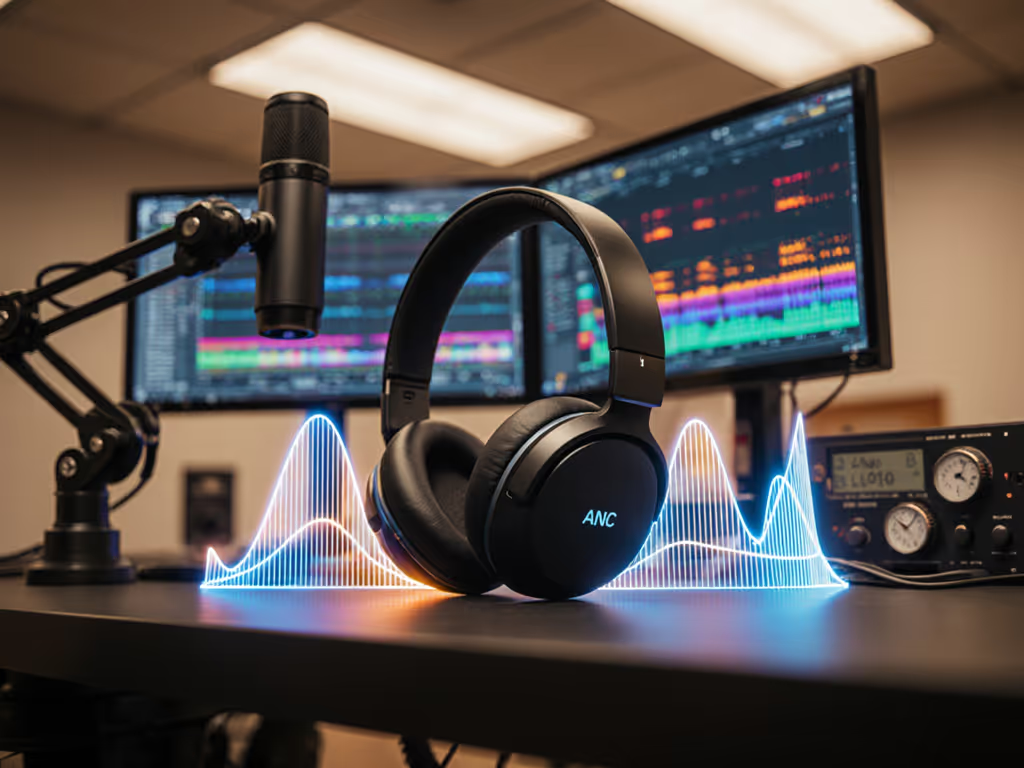
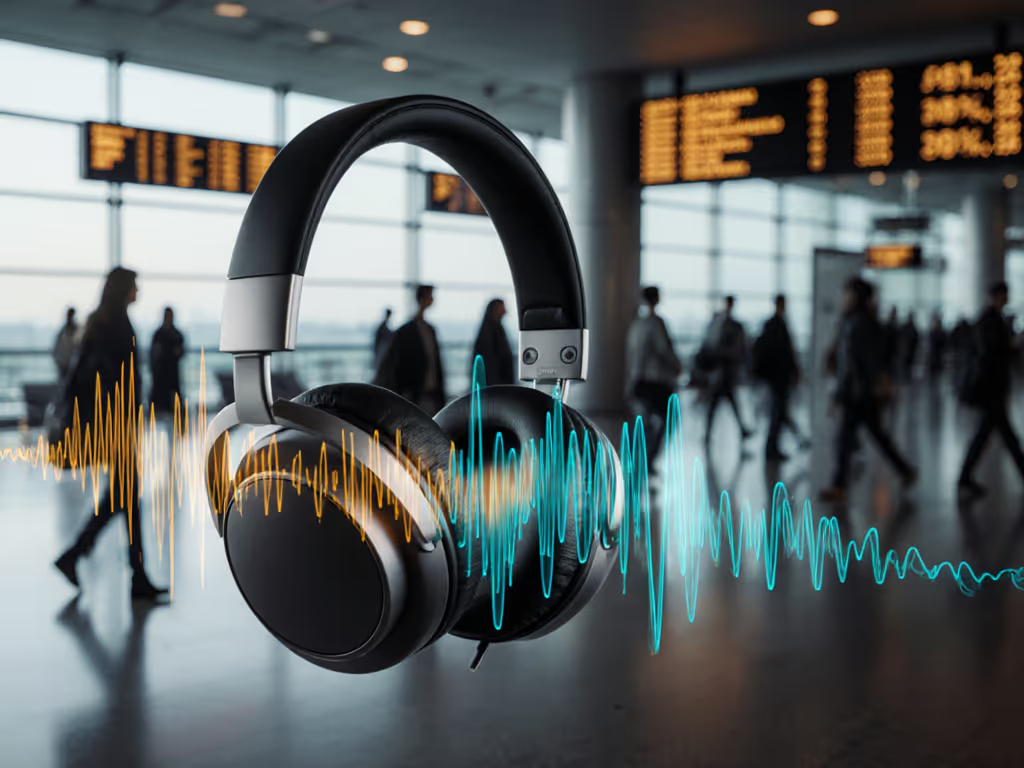
ANC systems work by generating an inverse sound wave (180 degrees out of phase with incoming noise) to cancel it out. This approach succeeds brilliantly with predictable, steady-state sources: jet engines, HVAC units, train wheels, and rumbling bass. These sounds repeat in patterns that microphones can learn and counteract reliably.
Human speech, by contrast, is fundamentally unpredictable. Every syllable, pitch variation, and pause differs from the last. The voice frequency noise reduction challenge stems from speech spanning the full acoustic spectrum, from low rumbles below 85 Hz to high consonants above 4,000 Hz. A single sentence contains multiple frequency components changing in real time, making it nearly impossible for an ANC algorithm to predict and generate the inverse wave before the sound reaches your ear. [1]
Why Don't ANC Systems Just Learn Voice Patterns?
This is where speech pattern noise cancellation theory confronts practical reality. While research demonstrates that AI voice clones can achieve remarkable acoustic fidelity, in some studies approaching human-level intelligibility [2], human speech carries an inherent variability that defies simple pattern matching.
Consider the acoustic characteristics of natural speech: inflection, hesitation, emotional undertone, and individual voice identity all encode information that ANC algorithms must either ignore or attempt to parse in milliseconds. Machine learning models can be trained on specific synthetic voices or repetitive speech, but they fail when confronted with the spontaneous, contextual nature of real conversation. A colleague's tone shift mid-sentence, an unexpected interruption, or regional accent variation... these deviations break the acoustic model ANC relies on.
Additionally, the latency problem compounds the challenge. Modern ANC systems require 5-15 milliseconds to analyze incoming sound and generate a countermeasure. Human speech dynamics occur within 10-50 milliseconds per phoneme. The system is often reacting to what you already heard, not preventing it.
Is Office Chatter Really Impossible to Cancel?
Not impossible, but severely limited. Office chatter ANC effectiveness depends heavily on frequency range and spatial separation. Steady, low-frequency office ambient noise (HVAC systems, ventilation hum, elevator machinery) cancels effectively. But intelligible human speech occupies the 300-3,500 Hz band where ANC typically shows 3-10 dB of attenuation at best, compared to 15-30 dB in low-frequency ranges. [1]
This matters practically: while ANC might reduce the volume of office chatter, it preserves intelligibility. You still understand what colleagues are saying, and the distraction remains intact. Some advanced systems attempt adaptive voice ANC technology that prioritizes canceling non-speech noise while preserving or gently attenuating speech, but these trade-offs often reduce overall quiet or introduce artifacts like slight compression, or an unnatural quality to the remaining audio.
The spatial component also limits effectiveness. If you're trying to keep callers from hearing your background rather than blocking it for yourself, see ANC vs ENC explained (ENC targets your outgoing mic noise, not what you hear). Sound from directly in front of you (a colleague speaking) reaches both ears differently than sound from equipment behind you. Dual microphone arrays can create limited directional cancellation, but engineering true "cocktail party effect" reversal (isolating one voice while canceling others) remains an unsolved problem for consumer headphones.
How Do AI Voice Clones Differ from Human Speech in This Context?
Research reveals an important distinction: AI-generated voice clones, when trained on minimal audio (as little as 10 seconds), demonstrate superior intelligibility in noisy environments compared to natural human speech, achieving up to 20% better clarity. [3] This paradox holds a clue to why human voices challenge ANC.
Synthetic voices are optimized for acoustic clarity: consistent formant structure, predictable pitch contours, minimal extraneous acoustic variance. They are engineered for transmission efficiency. Natural voices, by contrast, encode emotional nuance, individual identity markers, and spontaneous variation... features that make them rich but acoustically messy from an ANC perspective. The very characteristics that make human speech emotionally resonant and contextually meaningful make it harder to predict and cancel.
This suggests a fundamental trade-off: voices engineered for maximum clarity and predictability (like AI clones) are easier for ANC systems to model, but they sacrifice the emotional and social depth that human-to-human communication carries. [3] ANC systems cannot cancel human speech without sacrificing the intelligibility and identity markers that make that speech meaningful.
What Acoustic Frequencies Do ANC Systems Miss Most with Speech?
The vulnerability lies in specific frequency windows. For environment-by-environment results, see our frequency-specific ANC guide to match headphones to chatter-heavy spaces. ANC struggles most in the 1,000-4,000 Hz range, where consonants (particularly sibilants like "s," "sh," and "th") and vowel definition live. This band is where speech intelligibility concentrates; losing it causes comprehension to collapse. [1]
Low-frequency rumble and machine noise fall into ranges where headphone drivers and passive isolation can be tuned to maximize ANC. High-frequency hiss and environmental noise above 5,000 Hz can be addressed through passive ear cup design and careful microphone placement. But the mid-range speech band requires active cancellation that must adapt in real time to a constantly shifting acoustic target.
Furthermore, speech dynamics (sudden volume changes, whispered tones, or raised voices) exceed the dynamic range that many ANC systems can track. Sudden spikes in speech level can saturate the system's microphone or processing chain, causing distortion or pumping artifacts that listeners experience as pressure or an unnatural quality.
Does Comfort Impact How Well You Tolerate Uncanceled Speech?
A practical but overlooked factor: discomfort from prolonged ANC use or poor fit directly influences how distracting remaining noise becomes. After a ten-hour workday in an open office with persistent HVAC noise and overlapping conversations, the physical fatigue from ear pressure or clamp force can lower your acoustic tolerance threshold. What might have been manageable mid-morning becomes intolerable by afternoon, not because the ANC changed, but because your sustained attention depleted and discomfort amplified perception.
This connects to a broader principle: sustainable focus depends on comfort as much as noise reduction. If your system delivers 20 dB of attenuation but requires you to maintain 3.8 kPa of clamp pressure for eight hours, the residual fatigue undermines the benefit of the quiet you gained. Conversely, a lighter headphone with 15 dB of attenuation and negligible clamp force may deliver better net focus because you are not fighting physical pressure alongside remaining noise. Comfort you forget, protection you feel (that measurement applies equally to ANC performance and the ergonomic reality of wearing it all day).
Implications for Real-World Use
Understanding why human voices challenge ANC shifts expectations. The technology excels at steady environmental noise (planes, trains, machinery, rumble) where predictability and low-frequency dominance play to its strengths. But it will always struggle with speech because speech is, by design, unpredictable and information-dense.
For open-office workers, transit commuters, and anyone in voice-dominated environments, this means ANC alone cannot isolate you from human communication. Passive isolation, transparency modes for selective speech clarity, and workplace design (quieter zones, acoustic panels, meeting discipline) remain essential complements to active cancellation.
Further Exploration
This technical understanding invites deeper investigation: How do different ANC algorithms rank in speech attenuation versus rumble cancellation? Which headphone designs (over-ear versus earbuds) perform better in open offices where speech comes from multiple directions? We compare real-world trade-offs in our over-ear vs in-ear ANC guide. How do individual differences in ear anatomy and hearing sensitivity influence perceived effectiveness of speech cancellation? These questions matter because they close the gap between marketing claims and measurable performance in the specific environments where you work and travel.
The path forward begins with honest acknowledgment: ANC cannot silence human voices without sacrificing what makes speech meaningful. The engineering question is not whether to cancel speech, but where and how much to attenuate it while preserving intelligibility, a nuance often overlooked in pursuit of maximum quiet.