Open Ear vs Over Ear ANC for Commuters and Office Work
By Quinn Park • 21st Sep

Quick verdict
For commuters and office workers, choose over-ear ANC when your priority is reducing steady engine or HVAC noise at your ears. Choose open-ear bone conduction when hearing people and surroundings matters more than isolation.
- Choose open ear if: You need environmental awareness, an open ear canal, and a boom microphone for calls. Expect less isolation and possible sound leakage; the MAIRDI evidence does not establish listener-facing ANC.
- Choose over-ear ANC if: You want a quieter listening zone for flights, transit, or HVAC-heavy offices. The Cleer ENDURO ANC’s 25 dB reduction and 60-hour ANC-on battery are manufacturer claims, not independent test results.
- Main trade-off: Open ear favors awareness; over-ear favors attenuation. ANC can reduce low-frequency noise but will not reliably eliminate nearby voices.
Important: Neither product has independent comparative testing for comfort, call quality, or real-world battery life. Keep listening levels moderate and reduce volume during longer sessions.
The useful question in open-ear vs over-ear ANC is not which design has the more persuasive label. It is whether you need lower noise at your ears, better awareness of what is around you, or clearer outgoing speech on calls. That distinction matters because searches for noise canceling bone conduction headphones often put two different systems in one bucket: ANC reduces noise for the listener, while ENC is intended to reduce background noise picked up by a call microphone.
For transit rumble, aircraft engine hum, or persistent HVAC noise, an over-ear ANC design is the better-aligned category. For walking between traffic, working where you need to hear people nearby, or taking frequent calls without sealing your ears, an open-ear bone-conduction headset has a different advantage. Measure first; decide second.
I trust decibels, not adjectives, to judge quiet.
The short answer
Choose over-ear ANC when your primary problem is continuous low-frequency noise and you want a quieter personal listening or work zone. Active noise cancellation is particularly effective against lower-frequency sounds such as airplane-engine hum and HVAC noise; larger over-ear designs also generally block sound more effectively. Voices are a different problem: ANC is less effective against their higher-frequency content, so do not expect a silent office simply because ANC is switched on.
Choose open-ear bone conduction when situational awareness with ANC (or, more precisely, awareness instead of acoustic isolation) is the priority. Bone-conduction designs leave the ear canal open, so environmental sounds remain audible. That can be practical around people and movement, but it means the design is not creating the same quiet zone as an over-ear ANC headphone.
The most important correction: open ear noise cancelling headphones may refer to microphone noise reduction rather than listener-facing cancellation; our ANC vs ENC explanation clarifies the distinction. Read the feature description closely.
Start with the signal path: ANC and ENC solve different problems
ANC: noise reduction for what you hear
ANC is a listening feature. In the right conditions, it reduces the noise reaching you through the headphone playback path. Its clearest category-level use is steady, lower-frequency noise: aircraft engine hum and HVAC are common examples. Over-ear designs add a second advantage at the form-factor level: they generally block sound more effectively than smaller or open designs.
That does not make every over-ear model equally effective, and it does not mean every sound disappears. Speech remains a realistic interruption because ANC is less effective at higher-frequency sounds such as voices. Treat ANC numbers as manufacturer claims unless they are supported by clear, repeatable measurements from a trusted source.
ENC: background-noise reduction for your caller
ENC is about the microphone path. It attempts to make your voice more intelligible to the person on the other end of a call. It does not establish that the wearer receives less environmental noise.
This is the practical split:
| Your problem | Relevant feature | What it is not |
|---|---|---|
| Engine or HVAC noise makes you raise playback volume | Listener-facing ANC and an isolating form factor | A microphone ENC claim |
| Colleagues hear your surroundings on video calls | Mic system, boom position, and call-noise processing | Proof of quiet at your ears |
| You need to hear people or environmental cues nearby | Open-ear construction | A substitute for ANC |
For office work, a boom microphone may be preferable for video chats; our verified ANC mic-clarity tests offer more guidance on outgoing call quality. But microphone specifications alone do not show how much clearer your voice will be, and there are no independent call-intelligibility results for these two models here. Avoid treating phrases such as "AI noise canceling" or "clear voice capture" as a measured call-quality ranking.
The open-ear route: awareness first, quiet second
Bone conduction transmits sound through transducers that vibrate the skull while the ear canal remains open. The category-level result is straightforward: you can continue to hear environmental sound. The tradeoff is less isolation from that sound, plus the possibility that some playback is audible to people nearby depending on volume and use.
The MAIRDI Bluetooth Bone Conduction Headphone with Microphone Boom is an example of this task-specific approach. It is an open-ear bone-conduction headset with an adjustable boom microphone. Its retailer listing claims AI dual-mic ENC and up to 98% background-noise elimination for calls; that is an outbound microphone claim, not evidence of playback ANC. The same listing reports 32 g weight, up to 8 hours of music and calls, simultaneous connection to two Bluetooth devices, and an included USB Bluetooth adapter. These are retailer-reported specifications, not independently verified here.
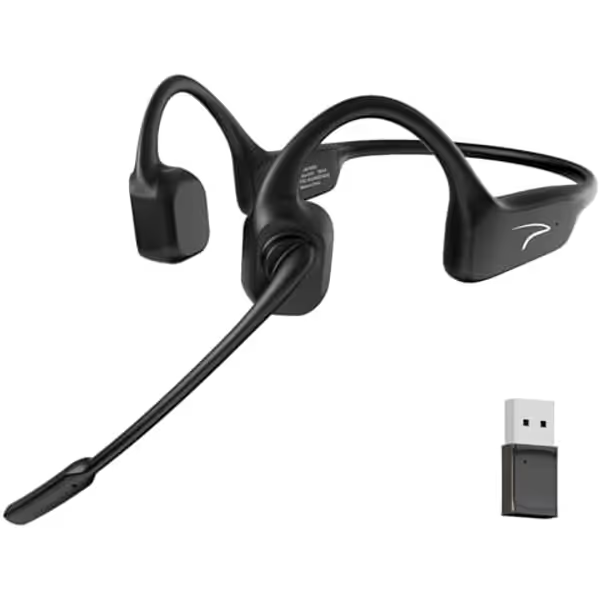
MAIRDI Bluetooth Bone Conduction Headphone
Open-ear comfort with clear calls and immersive audio for active use.
AI Mic Noise CancelingEliminates 98% background noise
AI Mic Noise CancelingEliminates 98% background noise
Pros
Clear calls in noisy environments with AI mic cancellation
Comfortable, lightweight open-ear design for all-day wear, even with glasses
Cons
Bone conduction audio may not suit all listeners
8-hour battery life may be short for very long travel days
For a hybrid worker, this profile can make sense when the requirement is: hear the room, speak into a boom mic, and move between a computer and phone. It is not the right expectation to buy it for train-car or aircraft-cabin attenuation. There is no indication here of listener-facing ANC for this model.
Where open ear works and where it does not
Better fit for:
- Calls where hearing nearby people is useful.
- Workflows that prioritize an open ear canal and environmental audibility.
- Users who value a boom mic format for office or video-chat use.
- Device switching, if the retailer-reported multipoint and USB adapter setup matches their desk.
Tradeoffs to accept:
- Nearby sound remains audible by design.
- Some of your audio may be audible to others, depending on volume and use.
- There is no independent battery or leakage test, or verified mic intelligibility data for this model here.
This is why "noise canceling bone conduction headphones" needs a second question: noise canceling for whom? In the MAIRDI listing, the supported answer is the person hearing you on a call, not necessarily you, the wearer.
The over-ear route: build a quieter work zone
Over-ear headphones are the more direct choice when the goal is attenuation. Their larger design generally blocks sound more effectively, and ANC targets the kind of steady low-frequency noise that makes flights and HVAC-heavy spaces tiring. On a red-eye to Seoul, swapping models under a cabin fan and a crying infant, the useful difference was never the longest feature list; it was the flatter attenuation behavior over time. Consistency is what lets you work or rest.
The Cleer Audio ENDURO ANC is an over-ear ANC headphone. Cleer states that its ANC reduces noise by 25 dB. That is a manufacturer claim, not an independently verified measurement here, so it should not be read as a guarantee of 25 dB in every frequency band, fit, or environment. Cleer also specifies a 280 g weight, up to 60 hours of battery life with ANC on, multipoint connectivity, a two-microphone Qualcomm cVc system, and passive line-in through a USB-C-to-3.5 mm input.
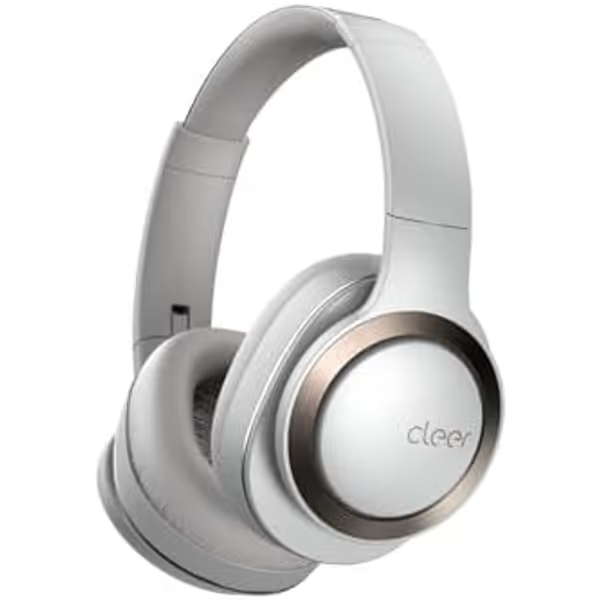
Cleer Audio Enduro ANC Headphones
Reliable quiet, clear calls, and immersive audio for all-day focus.
ANC Battery LifeUp to 60 hours
ANC Battery LifeUp to 60 hours
Pros
Distortion-free Hi-Res sound with aptX Adaptive.
Exceptional 60-hour ANC battery life and quick charge.
Cons
ANC performance may vary with specific high-frequency noises.
Some users report inconsistent battery life.
Customers praise sound quality, exceptional battery life, durability, and comfortable fit. Some isolated battery issues noted.
Customers praise sound quality, exceptional battery life, durability, and comfortable fit. Some isolated battery issues noted.
For a commuter or office worker, the relevant benefit is category fit: an over-ear design with stated ANC is intended to reduce what reaches the listener, whereas the MAIRDI model's documented noise-reduction claim applies to its microphone.
Where over-ear ANC works and where it does not
Better fit for:
- Travel and commutes with sustained engine-like or HVAC-like background noise.
- Focus sessions where lower environmental audibility is the objective.
- Long travel days where Cleer's stated up-to-60-hour ANC-on battery claim would cover more time between charges than the MAIRDI's retailer-stated up-to-8-hour claim.
- Users who want multipoint connectivity plus a wired listening option.
Tradeoffs to accept:
- Over-ear fit affects passive blocking and overall results; no model-specific fit or comfort testing is available here.
- ANC is not a reliable eraser for nearby voices.
- There is no independent test here of the 25 dB claim, real-world battery life, wind performance, or call intelligibility.
Commuter noise cancellation tradeoffs by environment
Use the environment's frequency-specific ANC profile, not a generic "best headphones" list, to choose.
Aircraft cabins and continuous transit noise
This is the strongest case for over-ear ANC. The documented category behavior favors ANC against lower-frequency aircraft-engine hum, while an over-ear design generally adds more blocking than an open configuration. The Cleer ENDURO ANC is the relevant option of these two because it has a stated listener-facing ANC function.
HVAC-heavy offices
ANC can reduce the lower-frequency HVAC component, but voices may still remain audible. If the constant ventilation layer is what drains your focus, choose over-ear ANC. If your job requires hearing coworkers without removing a headset, choose open ear and accept that you are choosing awareness rather than quiet.
Calls in a shared workspace
Separate your two success criteria:
- Do you need less room noise at your ears? Use over-ear ANC as the better-aligned form factor.
- Do others need to hear you more clearly? A boom microphone can be a sensible office format, but verify it in your own call environment because no comparative mic data is available for these two products here.
Walking and transitions between locations
Open ear keeps environmental sound audible by design. Over-ear ANC users should deliberately switch to ambient mode when awareness matters. Neither approach is automatically better; the safer workflow is the one that matches your immediate setting and attention demands.
A decision framework that avoids return fatigue
Before ordering, write down the one noise source you most need to manage and the one communication task you cannot compromise.
- "I need cabin/HVAC quiet at my ears." Choose over-ear ANC.
- "I need to hear the room while taking calls." Choose open-ear bone conduction with a boom mic.
- "I need both every day." Decide which failure costs more: missed environmental cues or persistent background noise. A two-device setup may be more rational than forcing one form factor into both roles.
- "Calls are my non-negotiable." Run a return-window test: make calls from your usual desk and a noisy location, then ask the other person about your speech and background (not merely whether the call connected).
For listening level, the broader guidance is about level and duration rather than headphone type. Sounds at or below 70 dB are considered safe according to CDC guidance relayed by Hearing Health Foundation, and lower volume becomes more important as listening time increases.
FAQ
Can bone conduction headphones be noise cancelling?
They can include noise-reducing microphone processing, but that is not the same as listener-facing ANC. For the MAIRDI model, the stated claim is AI dual-mic ENC for its boom microphone; there is no evidence here that it provides playback ANC.
Are there bone conduction headphones with a noise-canceling microphone?
Yes. The MAIRDI headset is listed with a boom microphone and AI dual-mic ENC. Treat the stated background-noise reduction as a retailer claim, not an independently measured call-performance result.
Do over-ear headphones have better ANC?
Not universally. But larger over-ear designs generally block sound more effectively, and ANC is effective against lower-frequency noise such as aircraft-engine hum and HVAC. Actual results still vary by model and fit.
Which is better: ANC or ENC?
Neither is better without a task. Choose ANC to reduce what you hear; choose ENC when clearer outgoing calls are the priority.
Final recommendation
For commuting, flights, and steady office HVAC noise, choose the Cleer ENDURO ANC if you want the form factor and manufacturer-stated ANC capability that target noise at your ears. For awareness-first work and boom-mic calls, choose the MAIRDI open-ear bone-conduction headset if its retailer-reported connectivity and battery profile fit your day, but do not buy it expecting listener-facing ANC.
Your actionable next step: list your top two locations, then label each quiet needed or awareness needed. If "quiet needed" wins, start with over-ear ANC. If "awareness needed" wins, start with open ear. That one-minute sort is more useful than comparing marketing adjectives.
Related Articles