Measure Professional Noise Cancelling Headphones With Your Phone
By Quinn Park • 6th Sep
What to do
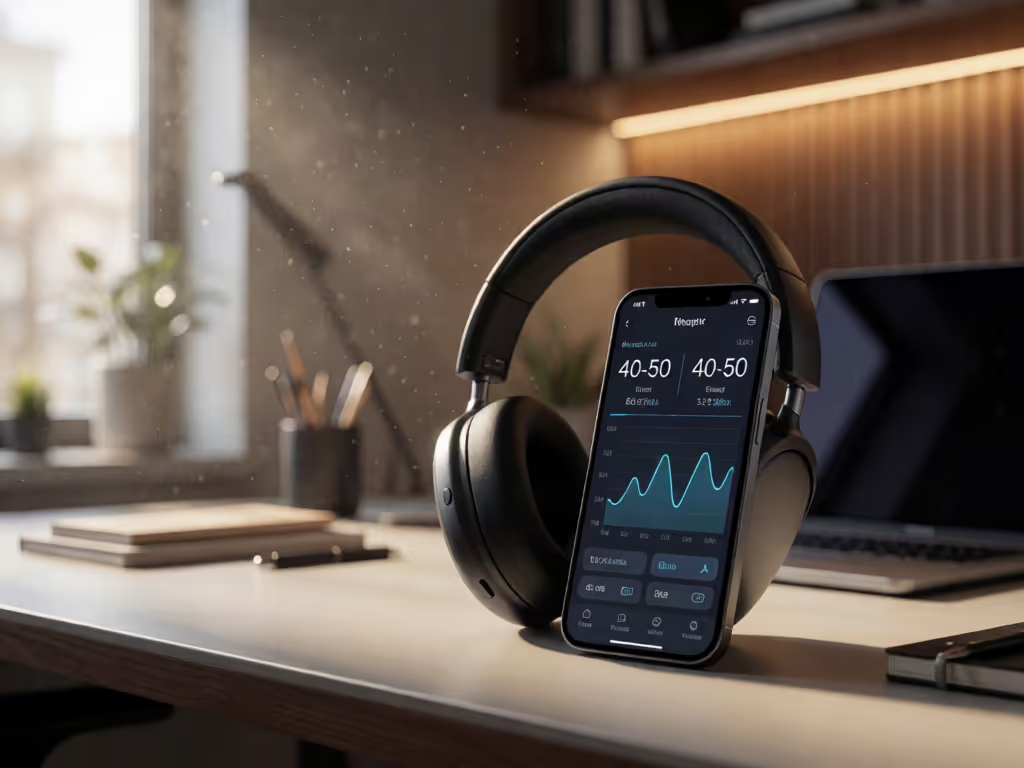
Use your phone to log a repeatable external noise condition and compare ANC-off with ANC-on listening. It cannot produce a validated dB reduction at your ear; the professional procedures described here use an ear simulator or HATS-based setup.
- Start with: Choose one stable sound source and keep the room, phone position, app settings, weighting, and playback level consistent.
- Then: Use the same logging duration for each condition, repeat the logs, and record headphone fit plus specific listening observations with ANC off and on. One real-world phone-app comparison used three one-minute recordings per sample.
- Important prerequisite: Calibrate the app when supported and treat the result as a local comparison, not a universal ANC score, ranking, or hearing-safety judgment.
Important: ANC is not hearing protection unless the product carries a Noise Reduction Rating (NRR); exposure risk depends on both sound level and duration.
Professional noise cancelling headphones deserve more than a brand claim and a quick toggle in a quiet room. You can use a phone to build a repeatable comparison of the noise around you and document how different settings feel in that same sound field. But a smartphone decibel meter ANC reading cannot tell you the true dB reduction reaching your ear. That distinction is the foundation of a useful DIY headphone noise reduction test: compare consistently, record conditions, and do not convert external readings into an ANC score.
I trust decibels, not adjectives, to judge quiet, but only when the decibels were collected at the right location. The useful signal is not a single headline number; it is whether your observations remain consistent while the external sound changes over time.
FAQ: What does "ANC performance" actually mean?
In professional testing, ANC performance is separated into three conditions:
- Unoccluded: Sound at the ear simulator with no headphones fitted.
- Passive attenuation: Sound with the headphones fitted and ANC off.
- Total attenuation: Sound with the headphones fitted and ANC on.
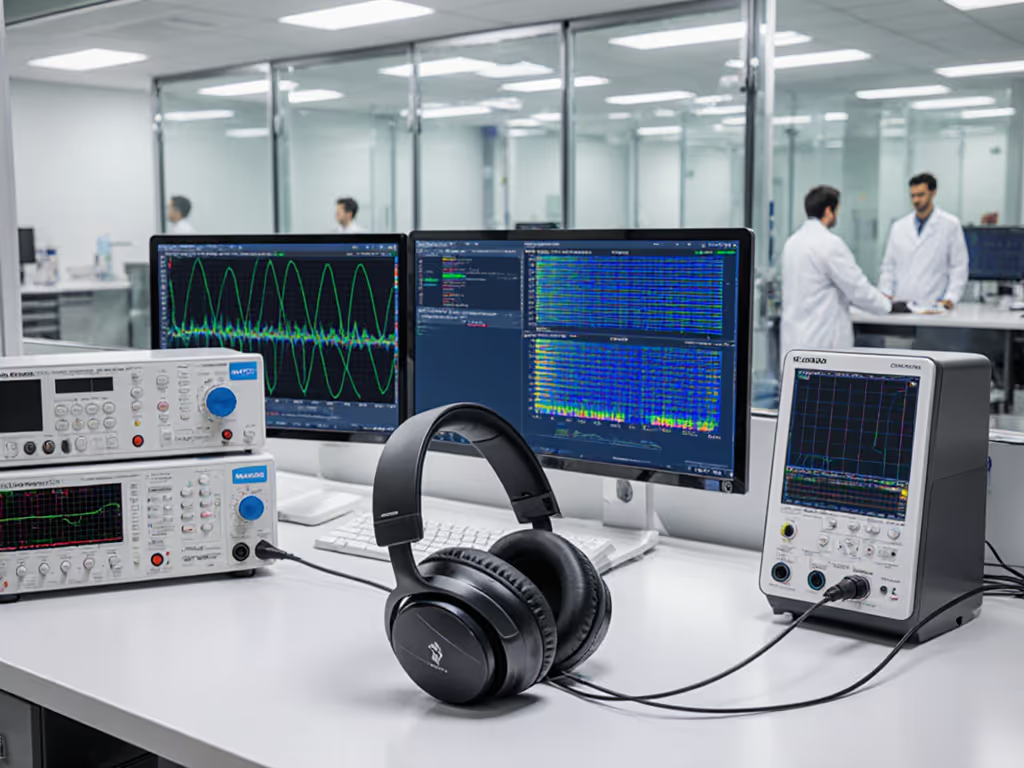
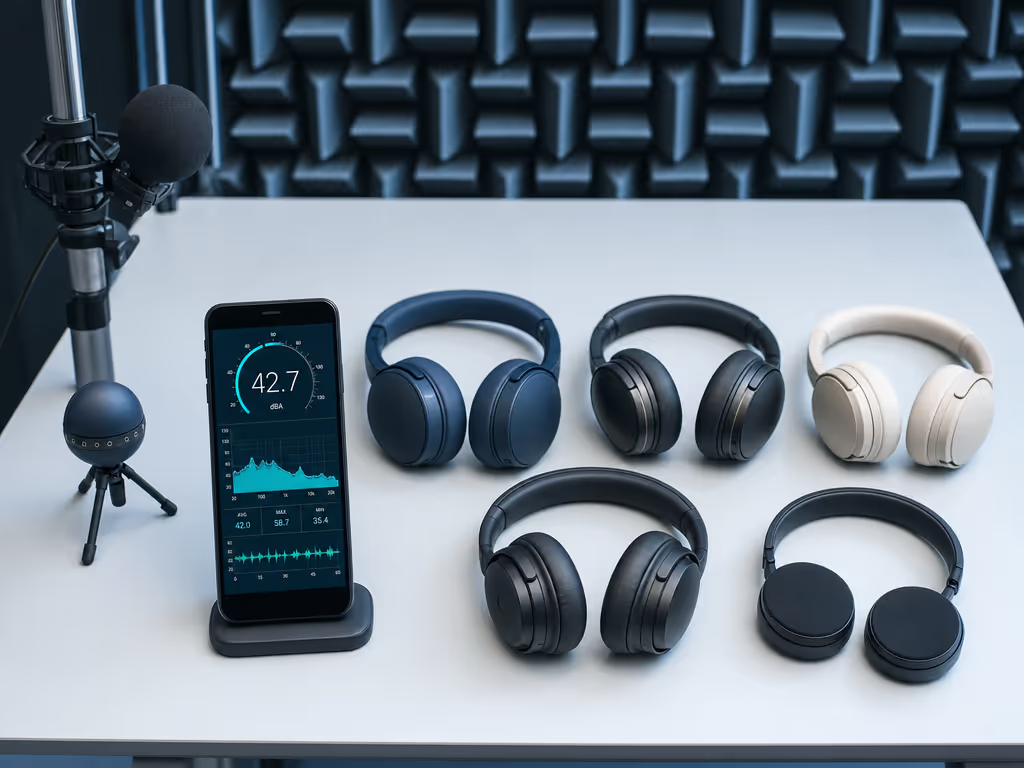
The difference between passive attenuation and total attenuation is the active noise-cancellation component. Professional setups use a head-and-torso simulator (HATS) or acoustic ear simulator, an artificial pinna, controlled external speakers, and a fitted headphone. That is the crucial detail: the measurement microphone sits at an ear-representative position behind the headphone.
A phone sitting on your desk, in contrast, measures the room sound field at the phone. It cannot see through the earcup or replicate your seal. It is still useful, but for a narrower job: logging the external noise you tested against and making each trial comparable.
FAQ: Can a smartphone decibel meter measure ANC?
Not as an ear-level attenuation measurement. A phone can report ambient level at its microphone, and some apps offer A-, C-, or Z-weighted readings plus averages and maximum levels. It cannot establish that a headphone reduces sound by the same number of dB at your ear.
That limitation matters because measurement position changes the question being answered:
- Phone in the room: "How loud and stable was the external sound during this trial?"
- Microphone at an ear simulator behind a fitted headphone: "How much sound reached an ear-representative measurement point?"
Do not place a phone inside an earcup, press a cup around its microphone, or subtract an ANC-on room reading from an ANC-off room reading. Those approaches do not establish ear-level attenuation. They create a number, not a validated result.
Phone-app accuracy also varies. In one NIOSH evaluation of 192 iOS and Android sound-measurement apps, only 4 iOS apps met a mean-difference criterion of ±2 dB(A) against a Type 1 reference meter. In a NIOSH follow-up study, apps used with external calibrated microphones agreed with a Type 1 reference meter within ±1 dB(A); that does not establish equivalent accuracy for a built-in phone microphone in headphone attenuation testing.
Use your phone as a controlled noise log, not an ear-level ANC meter.
FAQ: What is a useful home noise cancelling test protocol?
The goal is repeatable ANC performance. You are not producing a universal score or determining which model is "best." You are answering a local question: which setting or pair makes this repeated noise condition more manageable for me?
1. Choose one stable noise condition
Pick a sound that can run without interruption: a steady HVAC system, a bathroom fan, or a speaker playing a consistent noise track. Pink noise has equal noise energy across each octave interval, and professional headphone-isolation procedures have used it. Using it at home does not turn the test into a lab measurement.
Avoid sudden or variable sources: traffic passing a window, a conversation, or a kitchen appliance cycling on and off. If your target environment is a train platform or aircraft cabin, you can log it there, but label it as an observation, not a controlled comparison.
2. Lock the measurement setup
For every trial, keep these variables fixed:
- Same room, external sound source, and playback volume
- Same phone position, height, orientation, and distance from the source
- Same phone and app settings
- Phone removed from its case if the case could obstruct its microphone
- Same sound weighting and time weighting
- Same headphone fit, ANC mode, and test duration
Use the same sample duration for every noise log. A real-world phone-app comparison kept instruments at the same height and azimuth and used three one-minute recordings per sample; you can use that collection pattern as a repeatability control for your own log.
If your app and equipment support calibration, calibrate before and after each measurement. Record whether calibration was performed. Calibration is not optional paperwork: microphone sensitivity, environmental effects, and device condition can move readings.
3. Record external sound separately from headphone observations
Create two columns in a notes app or spreadsheet.
| Trial | External sound log | Headphone observation |
|---|---|---|
| 1 | Fixed-duration average, weighting, phone position | ANC off; fit notes; what is audible |
| 2 | Same setup, repeat external log | ANC on; same fit; what changed |
| 3 | Same setup, repeat external log | ANC on again; consistency check |
For the observation column, use specific language: "fan remains audible but less intrusive," "speech-like content remains understandable," or "seal changed after adjusting glasses." Avoid writing "20 dB cancellation" unless that number came from an ear-simulator or equivalent ear-level measurement, not from the phone outside the headphone.
4. Repeat on another day
A single session can be distorted by a shifted earcup seal, a different seating position, or external noise drift. Fit variation affects measured isolation even in controlled laboratory work; one described lab procedure took four measurements per headphone for that reason. If the second session produces a different result, report the variance rather than averaging it into false certainty.
FAQ: Should ANC be on or off during the test?
Use both. ANC off captures the headphone’s passive isolation in your listening observation. ANC on captures total isolation as you experience it. The comparison is meaningful only if fit and external sound are held as steady as practical.
Do not use this test to decide whether ANC should always be enabled in daily life. The protocol only answers whether its ANC-on mode changes your experience under the specific conditions you logged.
FAQ: Which settings should I log for a Quiet Map?
A practical Quiet Map is a route-specific record, not a validated ANC attenuation measurement. The ANC measurement procedure described for professional testing uses controlled conditions and an ear simulator or HATS. It is a route-specific record of conditions you can reproduce or encounter regularly.
Use entries such as:
- HVAC office: steady ventilation; log a fixed-duration external average and whether concentration improves with ANC on.
- Transit wait: variable mechanical and speech noise; note duration, location, and how stable the result feels across trials.
- Flight cabin: record seat area, approximate time in flight, and recurring sound sources. Cabin noise changes, so one reading is context, not a rating.
- Windy street: log wind exposure separately.
For calls, run a separate microphone clarity and intelligibility check with a willing listener. Keep the route, position, and background condition consistent, then ask for a simple pass/fail record: intelligible throughout, intermittently unclear, or unclear.
Check the Quiet Map for your route. The useful winner is the pair or setting that remains repeatable in the environments that consume your attention.
FAQ: What dB result is considered good ANC?
There is no universal phone-derived dB threshold that defines "good ANC." A dB value without the microphone position, noise spectrum, headphone fit, ANC mode, weighting, averaging time, and test environment is not comparable.
You may see 90 dB pink noise in a controlled laboratory isolation procedure, but that is a specified test stimulus within a HATS-based setup. It is not an ANC quality benchmark.
Likewise, do not use a phone reading to decide that an exposure is safe. NIOSH's occupational recommendation is 85 dB(A) as an eight-hour time-weighted average with a 3-dB exchange rate, and noise dose depends on both level and duration. ANC is not hearing protection unless the product is labeled with a Noise Reduction Rating (NRR).
Summary and final verdict
A home noise cancelling test protocol can make your decision clearer, provided you define it honestly. Use a smartphone decibel meter to document a stable external sound field; maintain placement, settings, fit, and timing; take repeated fixed-duration logs; and pair those logs with precise ANC-off versus ANC-on listening notes.
The final verdict: your phone can support a disciplined comparison of professional noise cancelling headphones, but it cannot certify their attenuation at your ear. One described professional measurement procedure uses an ear simulator or HATS, controlled noise, and separate unoccluded, fitted-headphone, and ANC-enabled measurements. Keep the boundary intact, and your notes will be far more useful than a misleading single-number score.
Related Articles