Best Fast Charging ANC Headphones for Real-World Emergencies
By Amara Singh • 3rd Oct
At a glance
This guide documents a 15-minute emergency top-up claim for the Bose QuietComfort Ultra Headphones: the listing claims up to 2.5 hours of playback, or up to 2 hours with Immersive Audio. That is useful for a planned commute, call block, or airport wait—but not proof they are the category’s best.
- Documented 15-minute claim: Bose’s stated recovery makes this model worth considering when 15 minutes of charging can cover your next listening block. The same listing claims up to 24 hours of battery life, reduced to 18 hours with Immersive Audio. View on Amazon
- What decides it: Treat those figures as retailer-stated “up to” claims, not independent test results.
Important: No cross-brand testing or independent ANC measurements support a broader ranking, so verify the charging details that matter to your routine before buying.
If you are shopping for the best fast charging ANC headphones because a dead battery before boarding, commuting, or joining a call is an expensive kind of inconvenience, start with the number that matters: usable listening time regained per minute at the outlet. Good noise cancelling headphones also need to suit your noise and work routine, but for an emergency-charge purchase, a verified quick-charge claim is more valuable than a long feature list.
There is an important limit to this guide: it focuses on one model because that is where reliable, specific information is available, not a defensible cross-brand ranking. So this is a practical, numbered decision guide to the Bose QuietComfort Ultra Headphones: what its stated rapid top-up can cover, where the claim has limits, and how to decide whether that outcome earns a place in your bag.
1. Define an "emergency" before you pay for fast charging
Fast charging is not a specification to admire; it is recovery time. The useful question is not, "How fast does it charge from zero to full?" It is, "Can a short stop at a power source restore enough listening time for the next leg of my day?"
For most people, there are three real emergencies:
- The gate-area rescue: You discover the battery is low shortly before boarding and need enough runtime for a flight segment or airport wait.
- The commute-and-call rescue: A short charge between transit and a meeting needs to cover a noisy ride plus a call.
- The workday rescue: You forgot to charge overnight and need a meaningful block of focus time (not necessarily a completely replenished battery).
This distinction prevents an easy buying mistake. A big maximum battery-life figure helps planning, but it does not automatically mean the headphones are useful when you have 10 or 15 minutes. Conversely, a fast top-up claim is only worthwhile if the recovered runtime matches your actual block of use.
I once mapped a week of bus, subway, and wind-exposed walking noise against what I was spending each month. The surprising winner was not the most expensive option; it was the one that removed the most friction at the stops I actually used. The same principle applies here: calculate the emergency you repeatedly face, then buy the recovery that solves it.
2. Bose QuietComfort Ultra Headphones: the documented emergency-charge case
The Bose QuietComfort Ultra Headphones have a stated quick-charge claim of up to 2.5 hours of playback from a 15-minute charge. With Immersive Audio enabled, the stated result is up to 2 hours from 15 minutes. That is the key information for this model’s ANC emergency charging value.
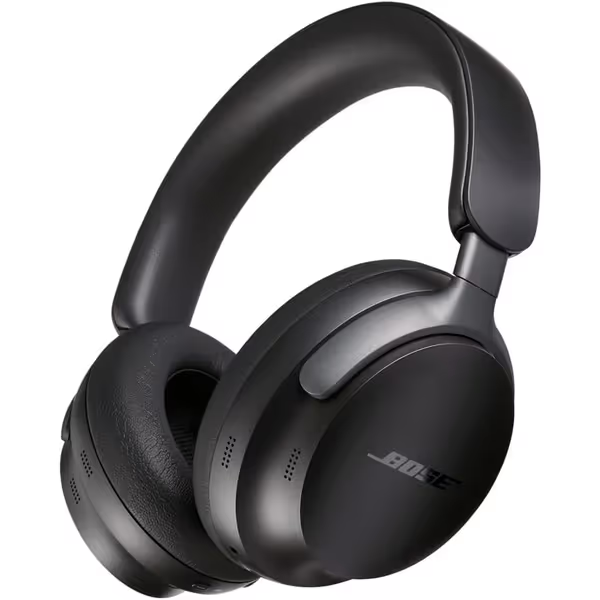
Bose QuietComfort Ultra Headphones
Immersive sound and strong noise cancellation for real-world quiet.
$429
Industry-leading ANCAdaptable Quiet, Aware, and Immersion modes
Industry-leading ANCAdaptable Quiet, Aware, and Immersion modes
Pros
Lab-verified ANC excels across diverse noisy environments (flights, subways, offices).
Crystal-clear voice pickup for calls, even in loud surroundings.
Cons
Bluetooth connectivity reports are occasionally inconsistent.
Battery life with Spatial Audio is shorter than advertised.
Customers find the headphones have excellent sound quality, great noise cancellation, and are comfortable, with one noting they don't cause ear discomfort. The Bluetooth connectivity and functionality receive mixed reviews - while some praise the flawless connection and exceptional performance, others report connectivity issues and unreliability. The battery life and value for money also get mixed feedback, with some praising the 24-hour capacity while others find it mediocre, and some consider them worth the price while others disagree.
Customers find the headphones have excellent sound quality, great noise cancellation, and are comfortable, with one noting they don't cause ear discomfort. The Bluetooth connectivity and functionality receive mixed reviews - while some praise the flawless connection and exceptional performance, others report connectivity issues and unreliability. The battery life and value for money also get mixed feedback, with some praising the 24-hour capacity while others find it mediocre, and some consider them worth the price while others disagree.
For a time-pressed listener, that works out to a simple planning rate:
- Standard stated quick-charge mode: up to 150 minutes regained in 15 minutes, or up to 10 minutes of listening per minute charging.
- With Immersive Audio: up to 120 minutes regained in 15 minutes, or up to 8 minutes of listening per minute charging.
Those are planning ratios, not guarantees. The claims are stated as "up to," and the conditions behind the test, including the battery level before charging, are not provided. Treat the result as an upper bound estimate when your schedule has no slack.
The listing also states a maximum of up to 24 hours of battery life, reduced to up to 18 hours with Immersive Audio. In other words, immersive processing carries a stated runtime cost both over a full charge and during a 15-minute recovery. If your priority is quiet during a long travel day, the practical choice is to reserve Immersive Audio for when you value it enough to accept that shorter claimed battery window.
Who this top-up is likely to suit
This profile makes the most sense for someone who can reliably find 15 minutes before the next listening block and wants a potentially substantial recovery. Think of the airport lounge, a desk before an afternoon call, or a cafe stop between appointments.
It is less reassuring for a traveler who only has a couple of minutes at the gate. There is no information here that lets us predict runtime from a five- or ten-minute charge, so do not extrapolate the 15-minute claim downward as though charging were perfectly linear.
Emergency charging is valuable only when the recovered time covers the next unavoidable stretch of noise.
3. Does the noise cancelling itself solve a noisy-day problem?
The Bose listing describes active noise cancellation and provides three modes: Quiet Mode, Aware Mode, and Immersion Mode. It says Immersion Mode combines full noise cancellation with Bose Immersive Audio. That establishes the available noise-control functions, but it does not establish how much sound these headphones reduce in an aircraft cabin, on a subway platform, in wind, or beside office chatter.
So, do noise-cancelling headphones actually work? They can provide a noise-cancellation function, and this product is explicitly listed with one, but there are no independent attenuation measurements here for the QuietComfort Ultra Headphones. It cannot support a claim that this model is best for plane rumble, train screech, voices, or wind.
That difference matters because "ANC" is not a single outcome. For a deeper look at how ANC performance changes with different noise types and frequency ranges, see this frequency-specific ANC guide. Your quiet map should separate:
- Steady low-frequency sound, such as vehicle or HVAC rumble.
- Variable, sharper sound, such as conversation, platform noise, and sudden outdoor gusts.
- Call conditions, where your outgoing voice matters as much as what you hear.
There are no independent call tests here for the QuietComfort Ultra Headphones. If calls are revenue-critical or you routinely take them outdoors, test your own typical route during the return period rather than accepting a marketing phrase as a result.
4. The trade-off to watch: runtime settings, not imaginary superpowers
A sensible emergency-ready setup has one job: avoid turning a 15-minute charge into an overconfident promise. On this model, the known trade-off is straightforward. The stated maximum falls from 24 to 18 hours when Immersive Audio is used, and the stated 15-minute quick-charge result falls from 2.5 to 2 hours.
That does not mean Immersive Audio is a bad feature. It means it should be a deliberate choice. If you are about to enter a long noisy stretch with little access to power, favor the setting that preserves the larger stated battery margin. If you are settled at a desk or have a dependable recharge point, the lower stated runtime may be acceptable.
There are several things you should not assume about this QuietComfort Ultra model:
- Its charging connector is not confirmed here. Do not present it as a confirmed USB-C fast charge headphones option.
- Supported charger wattage, USB Power Delivery behavior, and power-bank compatibility are not established here.
- Full charge time from empty is not established.
- It is not confirmed here whether it can play over Bluetooth, work through a cable, or maintain ANC while charging.
- There is no model-specific guidance here on how frequent emergency top-ups affect long-term battery health.
These gaps are purchase-relevant, not trivia. If your routine depends on a particular power bank, charging while working, or a known empty-to-full window, confirm those details in current official documentation or with the seller before committing. Better to verify first than to discover a limitation mid-trip.
5. Evaluate quiet-per-dollar without pretending every feature is equal
For best ANC headphones for battery emergencies, price alone is a weak filter. The better value test is whether a product’s documented recovery prevents a costly failure in your routine.
Use this three-part screen:
A. Put a number on the disruption
How often do you run low at the wrong time? Once a year is not a strong reason to spend more. Twice weekly, before a client call or a two-leg commute, may be. Multiply the number of likely emergencies by the time you recover using a quick top-up. That is your monthly ROI in usable quiet, not a vague sense that the battery is "good."
B. Match the stated recovery to one complete block
For the Bose QuietComfort Ultra Headphones, the stated 15-minute result is up to 2.5 hours without the Immersive Audio qualifier, or up to 2 hours with it. Ask whether that covers your actual block:
- a transit ride plus focused work,
- an airport delay plus boarding,
- or a meeting sequence after lunch.
If it does, the top-up claim has practical value. If you need six more hours with no power available, it is the wrong metric; the stated total runtime is more relevant.
C. Include lifetime friction
Quiet-per-dollar is not just purchase price divided by features. It includes how often a device causes a return, a missed call, an inconvenient recharge, or replacement before you expected it. Warranty coverage, battery service, and replacement-part availability belong in that calculation. No documentation for those items is available here, so they remain questions to verify rather than points in this model’s favor.
Spend for quiet, not for logos or launch hype. A premium pair only earns its cost if its documented recovery pattern maps to your route and workload.
6. Build a low-risk emergency charging routine
The headphones are only part of the system. A better routine reduces battery anxiety without relying on unsupported assumptions about charging behavior.
- Use the 15-minute benchmark as a buffer target. When time allows, build in a full 15-minute stop instead of gambling on a shorter one.
- Plan around the lower stated figure when Immersive Audio matters. For a conservative schedule, regard the up-to-two-hour claim as the relevant target when that mode is enabled.
- Charge before the critical block, not after the warning. The best recovery is the one you complete while you still have options: at your desk, gate area, or between meetings. Because emergency readiness also depends on hearing critical alerts, review how emergency sounds penetrate ANC headphones before relying on full isolation in public spaces.
- Verify your travel-power setup with current sources. Some airlines have restrictions involving portable-charger size, quantity, accessibility, and storage, and policies can change by airline and route. Check your carrier’s current rules before traveling.
- Test the scenario you actually live. During the return period, run a 15-minute charge, then use the headphones in your usual mode and environment. The stated figure is a useful ceiling; your result is the operational number that matters. You can also improve the result you get from existing headphones with these noise-cancelling settings and fit optimizations.
Do not turn this into a battery-health myth contest. No model-specific information here supports claims about the effects of partial charging, repeated quick top-ups, or leaving these headphones at a high charge. Follow the product’s current instructions and judge the purchase on the verified recovery outcome you can use.
7. Final verdict: a credible 15-minute recovery claim, not a proven category winner
The Bose QuietComfort Ultra Headphones are a sensible model to investigate if your decision centers on a documented short-charge recovery: the listing states up to 2.5 hours after 15 minutes, or up to 2 hours with Immersive Audio, alongside maximum stated battery figures of 24 and 18 hours respectively.
That makes them potentially practical for a planned 15-minute rescue before a commute, call block, or airport wait. But they cannot be crowned the best fast charging ANC headphones overall from the information available here. There is no cross-brand testing, no independent verification of the quick-charge result or ANC effectiveness, and no confirmed model details here on connector type, charger wattage, power-bank compatibility, charging while listening, or repair and battery service.
The no-regret move is simple: choose this model only if its stated 15-minute recovery covers your next real-world noise block, then verify the unanswered charging details that your routine depends on. That is how good noise cancelling headphones become a working tool rather than an expensive backup plan.
Related Articles