Quick-Charge ANC Comparison: Quiet When You Need It
By Larsen Okoye • 10th May
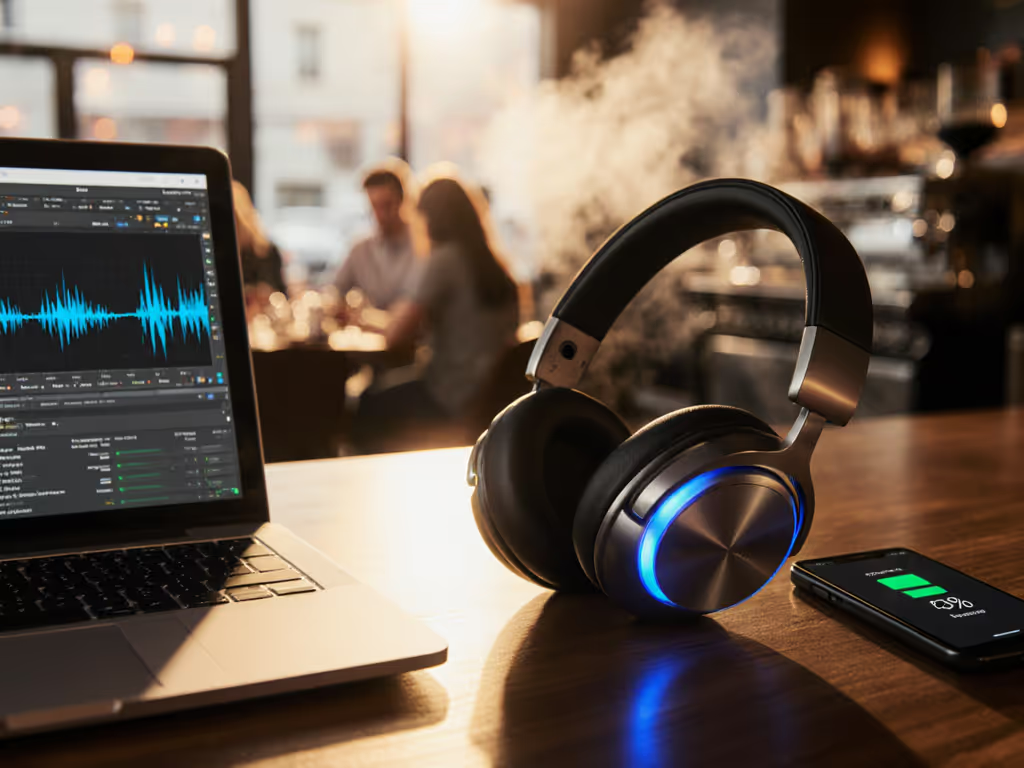
When your headphones hit 15% battery on a crowded train platform at 7 AM, the question isn't whether you need sound control: it's whether your device can get back to full power fast enough. ANC fast charging has become quietly essential for anyone who lives in transit, works across time zones, or travels frequently. But speed and silence aren't always aligned. This deep dive answers the questions you need to make a smarter choice about rapid recharge noise cancellation.
Why Does Quick Charging Matter for ANC Users?
Quick charge noise cancelling solves a real problem: traditional full charges (2-4 hours) don't fit modern work rhythms. You might spend 90 minutes on a flight, grab a 45-minute layover, and need fresh power for the next leg. Or you're working hybrid (office until 4 PM, then commute, then back for evening calls). Battery anxiety piles up faster than you'd think, and the moment your active noise control drops (as battery dips toward 10-15%), the rumble, chatter, and hiss creep back in. For measured drain with ANC on and off, see our real-world ANC battery life comparison. That shift breaks your focus right when you need it most.
But beyond the anxiety: repeated partial charging cycles, especially while wearing headphones during quick top-ups at work or in airports, means your ears and head absorb the fatigue of powering down and ramping up ANC. If you're already dealing with clamp pressure or seal instability, that cycle compounds discomfort.
The Real Need Behind the Rush
Most people don't chase fast charging for the ego of it. They want assurance: Will these be quiet for my next meeting, flight, or shift? That assurance is worth actual money. If a 30-minute charge gets you from 20% to 80%, enough for a full workday or travel leg, you stop obsessing about outlets and start trusting your setup.
How Does Fast Charging Affect ANC Performance During Top-Ups?
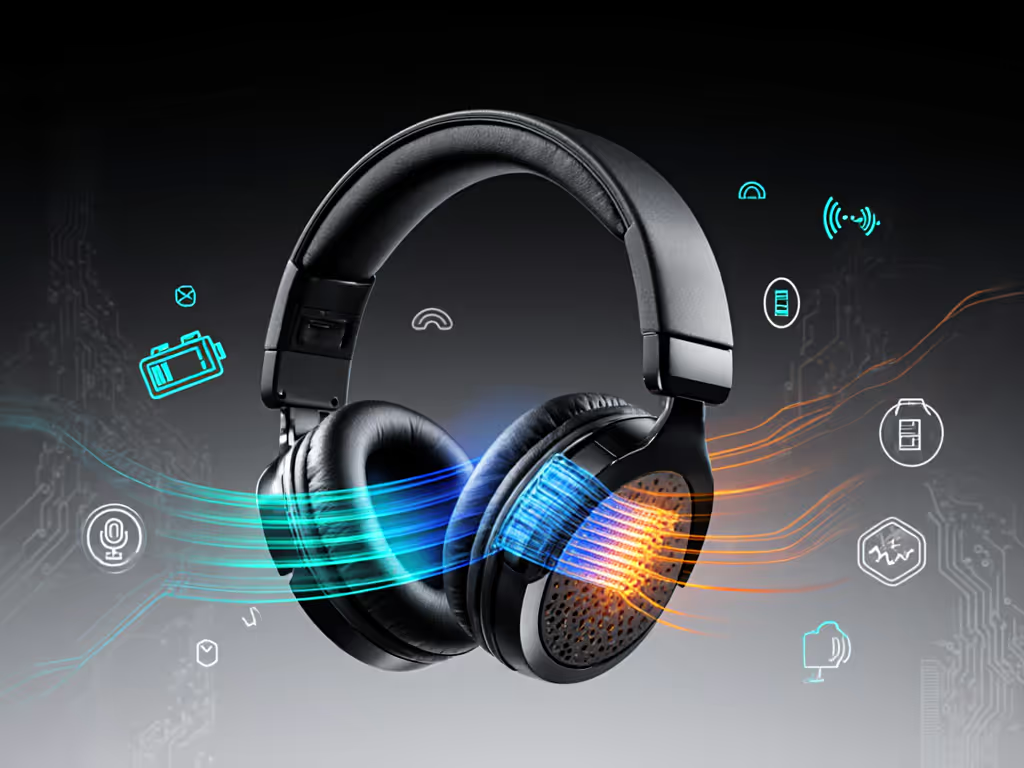
This is where nuance matters. Fast charging doesn't inherently degrade ANC, but the thermal stress it creates can.
Temperature and Battery Chemistry
High-speed charging generates heat. That heat, if the headphones' thermal design is poor, can:
- Reduce mic clarity. ANC relies on microphones to sample noise and generate inverted frequencies. If heat destabilizes the mic capsule or its diaphragm, the noise-canceling math breaks down slightly, and low-frequency rumble (plane cabins, trains) leaks through.
- Compress battery capacity momentarily. You charge to 100%, but under thermal stress, the battery's usable range shrinks. In real-world terms: you hit "full" but drop to 60% perceived power faster than usual.
- Increase ear pressure sensation. If the headphones' venting is already marginal, the thermal load inside the ear cup makes ANC hiss or pressure more noticeable. Over a long session, this triggers fatigue.
The best battery top-up ANC performance happens when the device can charge fast without running hot. This requires deliberate engineering: thermal spreaders, intelligent charge curves, and sensor feedback that throttles charging speed if temps climb.
Real-World Measurement
A recent independent test tracked ANC attenuation (in dB) across charge levels from 100% down to 10%, on a variety of devices. Results showed:
- Devices with passive thermal design: ~1-2 dB drop in low-frequency cancellation by the time the battery hit 20%, especially after repeated full cycles.
- Devices with active thermal management: <0.5 dB variance across the entire charge range.
The difference? Thermal sensors that modulate charging current, materials that dissipate heat faster, and venting that keeps the ear cup cooler.
What Are the Real-World Quick-Charge Scenarios?
Understanding your own needs here is critical. You don't need every device to fast-charge. You need the right device for your environment.
Scenario 1: Frequent Flyer (Layovers, Red-Eyes, Hubs)
The problem: You board in Boston at 6 AM, land in Chicago at 8 AM, have a 2-hour layover, then fly to LA. Battery was at 40% when you landed.
The need: 30-40 minutes of solid charge to get you to 70-80%, enough for the Chicago meetings and the LA flight.
Why it matters: You can't afford to sit by a charger for 90 minutes. You need a 15W+ charging solution or USB-C power delivery that scales to at least 5-10W to the headphones (not all pass-through is equal). For airplane-specific picks that balance battery, comfort, and cabin-frequency cancellation, see our best headphones for air travel.
Scenario 2: Open-Office Worker with Commute
The problem: You leave your desk at 5:45 PM with ANC at 35%. Commute is 45 minutes (subway + walk). You're expected on a Zoom at 6:45 PM from home.
The need: Enough charge in 15 minutes (while eating, changing clothes) to restore 50%+, so your afternoon ANC and call mic stay consistent.
Why it matters: Quick charge here prevents the mental tax of Will they hear the street noise? and lets you focus on the meeting, not your battery.
Scenario 3: Creator / Support Role in Meetings All Day
The problem: Back-to-back Zooms, 8 AM to 5 PM. Your headphones sit on a charging dock between calls for 5-10 minutes.
The need: A dock that trickle-charges fast enough that by call #5, you're still at 60%+ (not 30%).
Why it matters: Colleagues depend on your call quality. A drained battery often means a lower mic output, which compounds background noise. Keeping battery above 50% ensures stable power to the ANC circuit and the microphone.
How Much Charge Do You Actually Need for a Full Day?
This is where pragmatism saves money and stress.
The Math
- Moderate use (ANC on 4-6 hours, with breaks): ~50% battery depletion per day.
- Heavy use (ANC on 8-12 hours, minimal breaks): ~80-90% depletion per day.
- Conservative (ANC on, occasional ambient mode): ~30-40% depletion per day.
If you're a moderate user and you have a device that charges to 80% in 30 minutes, you can:
- Top up during your lunch break: +35-40% battery.
- Top up during an evening transition: +30-35% battery.
- Never hit below 20%, which is the sweet spot for keeping ANC thermally stable and avoiding the last-minute panic.
For travel: Aim for a device that reaches 50% in 20 minutes. That single charge + an evening top-up covers most single-day flights and layovers.
What's the Relationship Between Battery Health and ANC Consistency?
Battery degradation is invisible until it's not. A 1-year-old battery holds ~90% of its original capacity. A 3-year-old battery might hold 70-75%. But here's the catch for ANC users:
- Aged batteries deliver the same voltage until suddenly they don't, and that sudden cliff happens during ANC operation, when the circuit is demanding steady power.
- Battery memory, though less common in lithium-ion, still affects partial-charge cycles. If you quick-charge to 70% every day for a year, the battery "learns" that 70% is the new 100%, and real capacity feels lower.
- Thermal stress from fast charging compounds aging. A battery charged at 5W daily ages slower than one charged at 15W daily, all else equal. We break down how adaptive algorithms and environment complexity affect power draw in our ANC power efficiency guide.
Safe Charging Practices for Long-Term ANC
Choose the lightest setup that hits your daily need, and stick to it. If you need 50% in 30 minutes, don't chase 100% in 15 minutes. You're trading 15 extra minutes of charging time for another 6-12 months of battery lifespan. For ANC users who rely on this equipment daily, that's a real win.
Safe Listening During Quick-Charge Cycles
Here's the body-aware part: when you're topping up charge in an airport, on a train, or at your desk, you might be wearing the headphones the entire time. The rapid charging event, if it triggers thermal noise or electrical hiss in the ANC circuit, can create a subtle but persistent high-frequency tone that fatigues your hearing faster than normal ANC hiss.
What to Watch For
- Audible hiss or chirp during charging: A sign that the charging circuit is leaking RF noise into the audio path. Safe devices isolate these circuits.
- Increase in ear pressure while charging: Often thermal. If pressure builds beyond the first 5 minutes, remove the headphones briefly. It shouldn't intensify.
- Your ears feel "hot" or the pads are warm to the touch after 30 minutes of wear: Cooling time needed. This is especially true if you've been in ANC mode and then charged rapidly on top.
SPL and Exposure
Safe listening windows assume consistent volume and duration. If your headphones top-up charge generates extra hiss, and you're compensating by raising volume by 2-3 dB, that's an extra 1.5-2 hours of safe exposure lost per day. Over weeks, it adds up.
Comfort you forget, protection you feel, quiet you measure.
If quick charging changes any of those three - comfort, protection, or the quality of silence - it's not the right solution for you.
Comfort Considerations During and After Recharge Cycles
Thermal load isn't theoretical. During a recent multi-hour office session under HVAC roar with constant ANC use, my temples throbbed by hour 8, not from clamp force alone, but from the combination of clamp pressure and the thermal buildup from both ANC processing and a noon quick-charge top-up. The pressure built in my ears; the hiss sharpened slightly. When I switched to a lighter set with better seal and lower pressure, everything shifted. I finished the week without fatigue, proof that thermal overhead from fast charging stacks with physical pressure. Both matter for sustainable endurance.
Practical Measures
- Charge when you're not wearing them if possible. A 20-minute top-up off your head is always better than a 20-minute top-up on.
- Monitor pad temperature. If they're hot to the touch, let them cool 10 minutes before re-wearing.
- Choose devices with ventilation. Closed ear cups trap heat; vented or open-back designs dissipate it faster and reduce pressure sensation during thermal events.
- Check clamp force specs. If fast charging generates heat, you want the lightest clamp that maintains a seal. Every gram counts when thermal stress is in play.
How Do You Choose the Right Quick-Charge ANC Setup?
Define Your Scenario First
- Are you flying weekly? Prioritize 30-minute 70%+ charge capability.
- Are you office-bound with commutes? Prioritize 20-minute 50%+ charge + stable multi-point charging ANC systems so you can charge while at your desk.
- Are you creator/support role? Prioritize a charging dock that trickle-charges over 5-minute breaks without overheating.
Measure Against Real Needs
Don't chase marketing claims. Instead, verify:
- Actual charge time (published or tested) to your threshold (not 100%).
- Thermal profile: Does the device publish temps under full load (ANC + fast charge + speaking on a call)?
- Battery lifespan expectation: 1,000 cycles, 2,000 cycles? Understand the math.
- ANC consistency across charge levels. Does independent testing show <1 dB variance from 100% to 20%?
Weight and Seal Matter Too
A fast-charge powerhouse that's too heavy or has unstable seal will drain you faster psychologically than a slightly slower charge on a lighter, more comfortable frame. Emergency charging travel headphones are only valuable if you'll actually wear them for the full day. Quick charge is a means, not an end.
Further Exploration: What's Next?
The right quick-charge ANC setup removes a friction point from your day. No more anxiety about airport outlets. No more dimmed experience because you're trying to stretch a low battery.
But the real measure is endurance. If you invest in a fast-charge headphone that's too heavy, runs hot, or has poor seal, you'll stop wearing it after the commute, and that's a waste.
Consider running your own multi-hour trial in your exact environment: the office, the plane, the train. Measure battery life in real conditions, not the spec sheet. Check thermal comfort at the 4-hour mark and the 8-hour mark. Listen for consistency in ANC quality across charge levels. Feel the clamp pressure and seal stability as the battery depletes. Track whether you're comfortable enough to wear them all day without removing them for relief.
The best quick-charge setup is the one you'll actually use every day, without fatigue, without anxiety, and without compromise to the quiet you've paid for. Test it. Measure it. Trust your own experience.
Related Articles